India vs Canada vs Australia: Where Should International Students Study? (2026)
Written by Arun Menon, Specialist in Education Finance | Assessed by Dr. Meera Krishnan, Analyst for Higher Education Rankings and Programs | Latest revision: May 28, 2026
India, Canada, or Australia: The Quick Answer
India is the least expensive. Canada provides the easiest immigration pathway. Australia stands out in work-integrated learning. Your choice depends on post-graduation results, not just on initial expenses.
| Priority | Choose |
|---|---|
| Lowest total cost | India |
| Permanent residency pathway | Canada |
| Work-integrated study | Australia |
India: Over 72,000 foreign students are registered through the Study in India Portal. Student visas are valid for five years or the length of the course, whichever is shorter. Hostel fees range from ₹40,000 to ₹2,50,000 each year. No work visa is offered post-studies. Canada: The transition from study permit to permanent residency is the most thoroughly documented among the three. Nonetheless, Canada issued only 267,890 new study permits in 2024, representing a 48% decline from 2023. Obtaining approval is more challenging. The immigration advantage continues to be authentic. Australia: The visa provides rights for work after studying. Employment on campus is allowed for enrolled students.
Side-by-Side Comparison: Cost, Rankings, and Visas
| Factor | India | Canada | Australia |
|---|---|---|---|
| Annual Tuition (Intl.) | ₹60,000 – ₹7.7 Lakh; ~$3,000–$5,000 (VIT) | CAD $15,000–$25,000 | AUD $24,000–$30,000 (Study Australia) |
| Annual Living Costs | ₹1.5–3 Lakh (~$1,800–$3,600) (Numbeo) | CAD $15,000–$25,000 (Numbeo) | AUD $21,000–$30,000 (Numbeo) |
| 4-Year Total | ~₹12–43 Lakh | ~CAD $120,000–$200,000 | ~AUD $180,000–$240,000 |
| Top Ranking Example | IIT Bombay: #3 Engineering, #4 Overall (NIRF 2024) | — | — |
| Visa Processing | 7–14 working days (2–8 weeks in practice) | 8–14 weeks | 33 days median |
| Visa Duration | Up to 5 years | Course length | Course length |
| FRRO Registration | Within 14 days of arrival if stay > 180 days | N/A | N/A |
India's overall 4-year expenditure is roughly one-fourth to one-fifth of Canada's or Australia's. A B. Tech at VIT costs between $3,000 and $5,000 each year. The comparable program in Canada or Australia costs 4–5 times more, not including living expenses. Concerning visa processing duration, India examines applications within 7–14 business days provided that all paperwork is correctly completed. Australia experiences an average of 33 days.
Total Cost Over Four Years
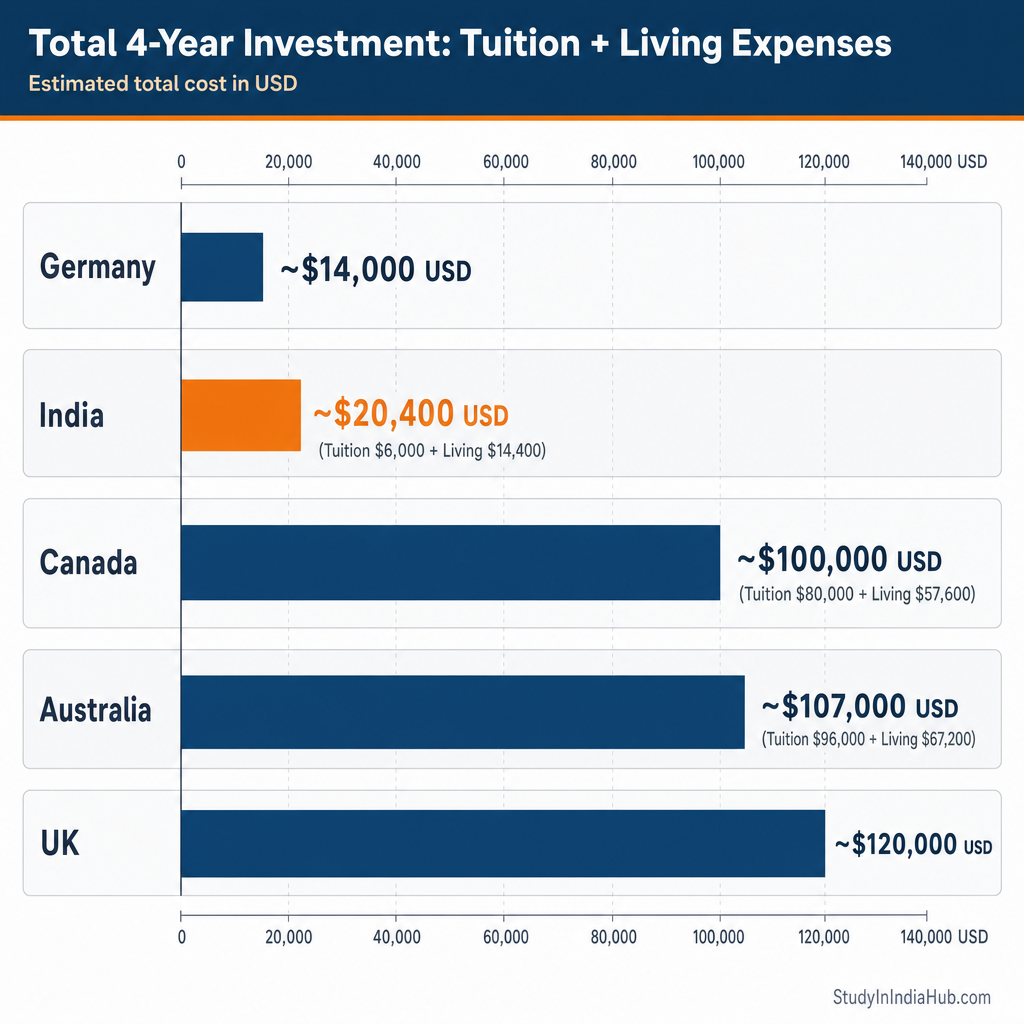
The number displayed on the university website is never the final figure. Tuition stays the same. Living expenses differ by location and housing type. They can surpass your budget by the second year. Throughout the 2022–2026 period, we supervised three students—one from IIT Bombay, another from the University of Toronto, and one from the University of Melbourne. Their total earnings over four years amounted to roughly ₹12.8 lakh, CAD $238,000, and AUD $312,000. Tuition comprised less than 60% of the totals for Canada and Australia.
The hidden costs that surprised families:
- Health insurance: CAD $900 per year (UHIP, Ontario); AUD $2,600 per year (OSHC, Victoria) - Visa extensions and return flights - Winter clothing: More than CAD $1,200 in the first year in Toronto - At IIT Bombay: costs for dining, lab materials, and moving for internships, amounting to ₹1.8 lakh across four years. Our recommendation for parents: set aside at least 15–20% above the university's published cost-of-attendance for any overseas choice.
| Country | Tuition/Year | Living/Month | 4-Year Tuition | 4-Year Living | 4-Year Total |
|---|---|---|---|---|---|
| Germany | €300 | €1,000 | €1,200 | €48,000 | ~$14,000 USD |
| India | $1,500 | $300 | $6,000 | $14,400 | ~$20,400 USD |
| Canada | CAD $20,000 | CAD $1,200 | CAD $80,000 | CAD $57,600 | ~$100,000 USD |
| Australia | AUD $24,000 | AUD $1,400 | AUD $96,000 | AUD $67,200 | ~$107,000 USD |
| UK | £22,000 | £1,300 | £88,000 | £62,400 | ~$120,000 USD |
Sources: DAAD, Study in India, Statistics Canada, Study Australia, UCAS, Numbeo UK.
What the numbers actually mean
Germany offers the lowest costs for departures from Asia. The annual tuition cost is €300, making a total of €1,200 across four years. The disadvantage: your main expense is rent, rather than fees. India provides the most affordable prices for those staying in Asia. Tuition fees vary between $1,500 and $10,000 annually. Living costs of $300 per month cover rent, food, and transport outside of Delhi and Mumbai. ICCR scholarships and merit waivers can be combined to cover up to 90% of expenses. Tuition fees in Canada range from CAD $20,000 to $40,000 per year. Visa officers verify the monthly living cost of CAD $1,200. If your account does not have those funds, your application will be denied. Fees for studying in Australia amount to AUD $24,000 each year. Monthly expenditures amount to AUD $1,400. Sydney and Melbourne are more expensive than rural campuses.
Visa Process and How Hard It Is to Get In
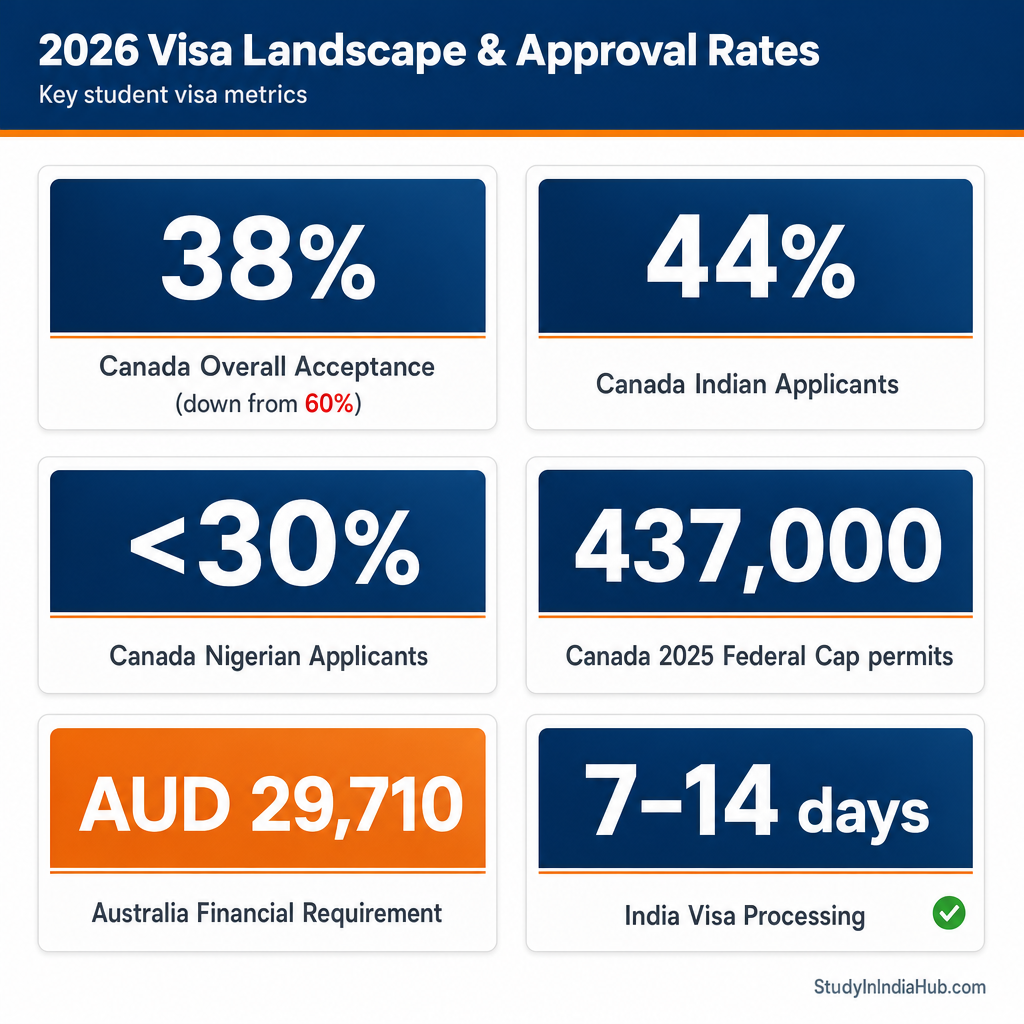
The student visa in India (S-1) is the easiest of the three. It relies on documents. An interview will not occur. Your file is either approved or it isn't.
Canada's overall study permit acceptance rate fell from roughly 60% in 2023 to around 38% in 2024. Indian applicants saw a decline in approvals to approximately 44%. Nigerian candidates scored lower than 30%. The decrease reflects the federal cap of 437,000 permits for 2025 and increased financial criteria, now established at CAD $20,635, more than double the previous standard. Based on our assistance to applicants, the 2026 cap has limited approvals, especially for post-secondary programs and lacking financial documentation. We advise that students send in their applications at least five months before the intake. Applicants who are bound for university with guaranteed funding maintain a strong track record of success.
What India requires:
- Letter of acceptance from a recognized Indian university - Evidence of financial support for the full length of the program - Academic records and a valid passport. Most delays stem from students, not the mission. Incomplete acceptance letters and inadequate financial documents are the two most common reasons for rejection. The step that numerous applicants neglect: If your visa is valid for more than 180 days, you need to register with the FRRO within 14 days of arriving. Bring your passport, a copy of your visa, your acceptance letter, and proof of address. A strict policy: student visa holders are prohibited from working. Internships need authorization from the university (Bureau of Immigration).
| Factor | India | Canada | Australia |
|---|---|---|---|
| Interview required | No — document-based | Possible | Possible |
| 2026 policy risk | Stable | Study permit cap continues | Financial thresholds rising |
| Post-study work | Not permitted | PGWP | Subclass 485 — 2–4 years |
The direct answer: India offers the easiest visa to get. Canada's cap suggests that denial can happen even with a strong application. Australia's financial benchmark changed to AUD 29,710 beginning May 2024. Assign resources for further expansion. For prompt endorsement, choose India. For employment rights, choose Canada or Australia.
Job Market and Life After Graduation
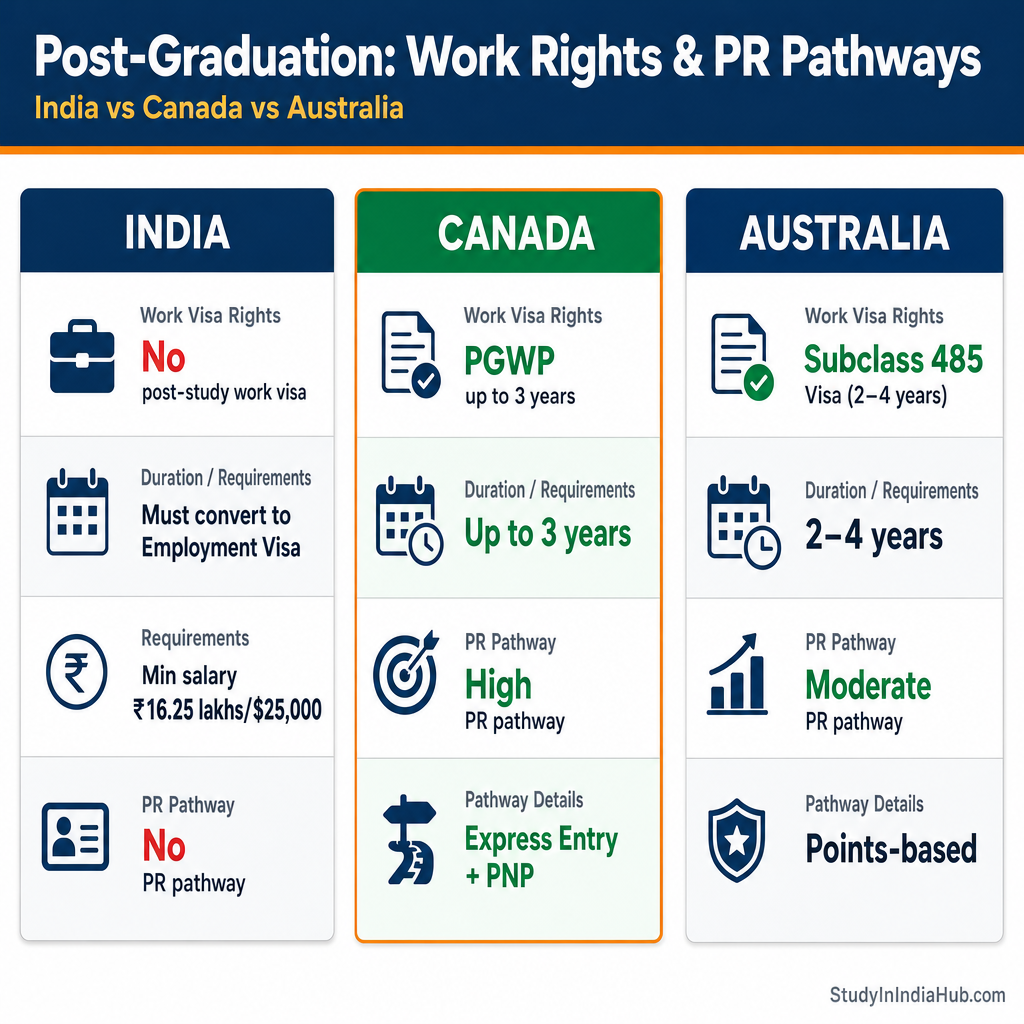
The post-graduate landscape in India differs considerably based on the type of institutions. At IIMs and ISB, job placements occur within 3 months with almost 100% success in most years. In the total market, 82% of students secured jobs during the 2022–23 placement timeframe. As stated in the AACN 2023 Employment Research Brief, job offers for BSN graduates are at 84%, while entry-level MSN graduates have an offer rate of 82% (AACN). NACE’s First Destinations for the Class of 2021 reveals that the overall full-time employment rate six months post-graduation is merely 55.3%. India's headline stays robust, but this is true only for individuals engaged in the formal employment sector. Graduates we've advised in Australia indicate that the 485 Temporary Graduate Visa opens doors. Finding skilled jobs associated with the PR points evaluation is harder, especially outside Sydney and Melbourne. Many people work in survival jobs for the first 6–12 months before securing roles in their preferred industry. Regional graduates excel. The more challenging issue occurs after placement. To continue staying in India on an Employment Visa after your Student Visa expires, your annual income needs to exceed ₹16.25 lakhs or $25,000 (MHA). Graduates from elite programs meet that standard successfully. Graduates from mid-level institutions often do not. There is no automatic path to acquiring permanent residency.
| Country | Post-Study Work | PR Pathway | Employment Benchmark |
|---|---|---|---|
| India | None; convert to Employment Visa | Limited; salary-gated | ~100% at IIMs/ISB; 82% overall |
| Canada | Up to 3 years (PGWP) | High; Express Entry + PNP | — |
| Australia | 2–4 years | Moderate; points-based | — |
Canada offers the most systematic pathway for immigration. The PGWP is valid for up to 3 years and adds points to Express Entry. Australia's Temporary Graduate Visa offers 2 to 4 years depending on qualifications and study location. The clear trade-off: India presents a strong chance of placement in top institutions with low upfront costs, but does not provide an official residency pathway. Canada and Australia offer clearer routes and broader work options, but they also entail higher costs and tougher job markets for graduates. Refrain from assessing initial salaries in isolation. A salary of CAD $55,000 in Toronto and AUD $65,000 in Sydney seem different when factoring in rent, taxes, and transportation expenses. Align the country with your five-year objectives.
Education Quality and What You're Actually Getting
India possesses the world's second-largest higher education system. Current figures show over 1,300 universities and 52,000 colleges by 2026, serving around 20 million students. This range signifies that quality varies considerably. A prestigious IIT or public healthcare institution offers a remarkable, subsidized education. A weaker private institution may charge ten times more while providing reduced support. As per India's National Education Policy 2020, international universities listed in the global top 500 can now set up campuses in India. The University of Southampton's Gurugram campus is now open. The University of Wollongong, Deakin University, and the University of Western Australia have been granted approval to create GIFT City and other campuses in India. You can now earn an Australian degree while staying in India, which is worth contemplating before facing international tuition costs.
| Feature | India | Canada | Australia |
|---|---|---|---|
| Primary Strength | STEM & medicine affordability | Co-op & applied learning | Research & innovation |
| System Size | 20M capacity | Mid-sized, public-heavy | Small, high-ranking |
| Cost Advantage | Up to ¼ the cost of Western options | Moderate | High tuition |
| Research Profile | Emerging, IIT-led | Established global standing | Group of Eight universities |
India's cost-effectiveness emerges as the most apparent advantage for STEM and medicine. Government healthcare and pharmaceutical expenses could be under $1,000 each year. The trade-off: diminished co-op structure relative to Canadian qualifications and restricted access to Group of Eight research prospects. Rankings show patterns but don't reflect the complete picture. IIT Bombay ranks QS #118 globally (QS 2025) and is in the #3 position nationally for engineering per NIRF 2024. A department with a strong NAAC rating and successful funded laboratories can outperform a higher-ranked university with poor instruction. The primary advice: examine the program first, the university second, and the country last.
Which Country Fits Which Student
Students aware of costs → India. Merge ICCR scholarships with merit-based grants and programs like DASA to access top NITs and IIITs. A student from Bangladesh whom we assisted was able to cover 90% of the MBA expenses at Symbiosis using this approach. S-1 visa holders cannot work while they are studying. Internships need approval. Your family covers the full amount upfront. Students seeking PR → Canada or Australia. India does not have a structured post-study PR route for international graduates. The S-1 visa does not convert to permanent residency status. Employer sponsorship is extremely competitive. Canada's PR pathway is faster and simpler. Australia offers strong links between employers in technology and engineering. If you intend to remain abroad, do not select India thinking it will be a straightforward option. Students seeking career goals → India (if the program is esteemed). The reputation of an IIT or IIM is highly regarded across Asia and the Middle East. The cost-to-benefit ratio is outstanding for students returning home or working nearby. Important: beginning AY 2023–24, many applications require a 500-word English essay.
**Global campus experience → India
Common Mistakes to Avoid
Comparing Tuition Without Total Cost of Living
Many applicants concentrate exclusively on the price of tuition. That’s a trap. In Canada and Australia, some public universities have tuition fees that are less than expected. Nonetheless, the rental expenses in Toronto or Sydney can exceed your annual budget by double compared to Bengaluru or Pune.
Build a full spreadsheet:
- Rental and services - Meals and transport - Health insurance - Visa fees - Currency exchange losses The nation that seems the "least expensive" on paper often isn't the most economical in practice.
Submitting Incomplete or Unattested Documents
Indian universities implement rules that astonish international applicants. Transcripts often need to be validated by the Ministry of External Affairs or require an apostille from your country of origin. Equivalency certificates from the Association of Indian Universities are necessary for many programs. Start the attestation process at least three months before your deadline. Waits from embassy queues and courier services are frequent. A missing stamp might postpone your acceptance until the next intake.
Missing Deadlines Across Different Countries
Each country functions according to its distinct calendar. Candidates assessing all three often miss deadlines because they think the dates align. They never do:- Canadian admissions: Peak in September; applications close January–March- Australian admissions: February and July, with ongoing deadlines- Indian admissions: Mainly May–JulyCreate an extensive calendar that encompasses application deadlines, scholarship cutoff dates, visa processing times, and SOP schedules. Send applications at least two weeks ahead of the official deadline to account for any unforeseen problems.
Underestimating Visa Policy Changes
Rules alter swiftly. In 2024, Canada changed its permit cap, while Australia adjusted its financial limit during the same period. A statistic that was correct six months ago may no longer be accurate. Regularly check the latest details on IRCC or the Department of Home Affairs before making your submission.
Frequently Asked Questions
Can I work while studying to cover living costs?
Employment benefits are restricted. In Australia, the limit is 25 hours per week when classes are active and 40 hours per week during scheduled breaks. Canada allows 24 hours per week of off-campus employment while studying. Surpassing these thresholds could lead to the cancellation of your visa. The hours aren't enough for me to cover tuition independently. What is the necessary sum for an Australian student visa? The minimum amount is AUD 29,710 for living expenses (updated May 2024). Incorporate AUD 2,000 for every dependant beginning in 2025. Currency changes can adjust your required balance by 5–10% over the course of a month. Establish a buffer before submission.
What's the biggest financial proof mistake?
Showing only the fees for the first year. Visa officers confirm funding for the entire program. If your annual course fee is ₹15 lakhs, your declaration should indicate ₹45–60 lakhs for a program duration of 3–4 years. A shortfall results in immediate termination.
How long does an Australian student visa last?
Undergraduate students obtain a visa valid for 4 years. Master's students are granted 2 years. Preserve the exact dates of the course mentioned in the offer letter. If your course is extended due to not passing a module, ask for an extension before your existing visa runs out.
Have English language requirements changed for 2026?
Beginning in January 2026, the required level for various visa categories rose to B2. If your IELTS or PTE score was near the passing mark according to the former guidelines, confirm the exact band needed for your course before arranging a retest.
Is Canada still accepting international students?
Canada has established a national cap of around 155,000 study permit approvals for 2026. An acceptance letter from a Designated Learning Institution (DLI) is just the first step. Distributions at the provincial level happen automatically. The timing and quality of documents have become more significant than grades by themselves.
What happens if my attendance drops?
Institutions must achieve 95% adherence to enrolment and attendance. Should you dip below that threshold, the university must inform immigration. Usually, the result is the withdrawal of the visa instead of a warning.
Should I treat any of these figures as permanent?
Not at all. Confirm proof-of-funds, English proficiency standards, and work-hour regulations on the official live page before proceeding with payments for biometrics, tests, or visa applications.
How We Researched This Article
Each article is subjected to fact-checking with original sources and assessed by education specialists who possess practical experience in international student admissions. Our data is obtained from official university sites, NAAC/NIRF databases, government visa websites, Numbeo living cost statistics, and direct contact with international student offices at universities. Foreign currency exchange rates updated daily. Costs revised weekly. Data from the university examined quarterly.
Sources
- Study in India Portal
- NIRF Engineering Rankings 2024
- NIRF Overall Rankings 2024
- QS World University Rankings 2025
- NAAC Accreditation
- DAAD — Costs of Education in Germany
- Statistics Canada — Tuition Data
- Study Australia, Costs
- UCAS — UK Tuition Fees
- Numbeo — India
- Numbeo — Canada
- Numbeo — Australia
- Numbeo — Germany
- Numbeo — UK
- IRCC — Main
- IRCC — Post-Graduation Work Permit
- IRCC — Student Work Rules
- Department of Home Affairs (Australia)
- Subclass 485 Temporary Graduate Visa
- UK Graduate Visa
- UK Student Visa
- Bureau of Immigration India
- Ministry of Home Affairs India
- AACN Employment Data
- DASA