India vs UK for International Students: Cost, Quality & ROI Compared (2026)
Authored by Arun Menon, Specialist in Education Finance | Most recent update: May 28, 2026
India vs UK for International Students: The Short Answer
The UK excels in global branding and rights for post-study work. India excels in affordability. Programs cost about a quarter of the price of similar UK degrees (indiainatlanta.gov.in). Neither nation is an all-encompassing victor.
Your decision comes down to three things:
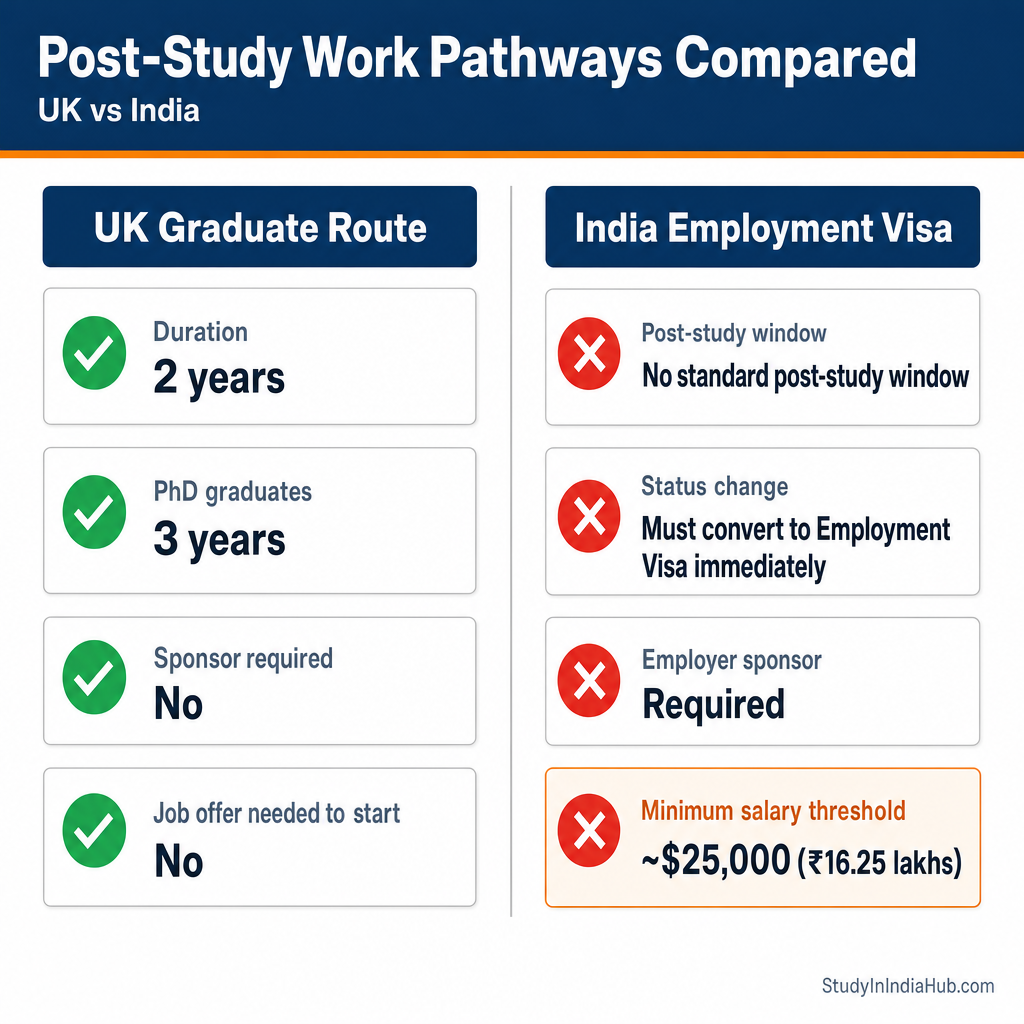
- Your financial plan- The location you wish to work at post-graduation- If your prospective employers demand a particular certificationThe UK's two-year Graduate Route visa (UK Government) provides automatic rights for post-study employment. An employer is not required for sponsorship from the very first day. In India, you must have an employer to back your Employment Visa following graduation. The lowest annual salary is approximately USD $25,000 (Ministry of Home Affairs). That can be accomplished with effective planning. However, the UK omits this step.
If your desired employers are in English-speaking or Gulf regions and your family can manage UK expenses, the UK offers distinct benefits. If you're budget-minded or your professional connections are in South Asia, India provides significant value. A complete MBA at Symbiosis can be less than ₹20 lakhs with combined scholarships (indiainatlanta.gov.in).
Total Cost Comparison: Tuition, Living, and Visa Fees
India operates 60–80% less expensive overall compared to the UK for the majority of programs. However, that difference diminishes when you assess a leading Indian institution against a mid-ranking UK university. The listed tuition amount is just part of the story. The actual amount consists of tuition plus 12 months of living expenses and the visa fee.
Annual Cost Breakdown
| Expense Category | India | UK |
|---|---|---|
| Tuition (per year) | ₹1,00,000–₹8,00,000 (Study in India Portal) | £22,000 (UCAS) |
| Living costs (per month) | ₹10,000–₹30,000 (Numbeo India) | £1,000–£1,500 outside London; £1,300–£2,000+ in London (Numbeo UK) |
| Student visa fee | Varies by country (HCIPOM) | £524 (UK Government) |
Two-Year Program: Total Cost Comparison
| Scenario | India (2 years) | UK (2 years) | India saving |
|---|---|---|---|
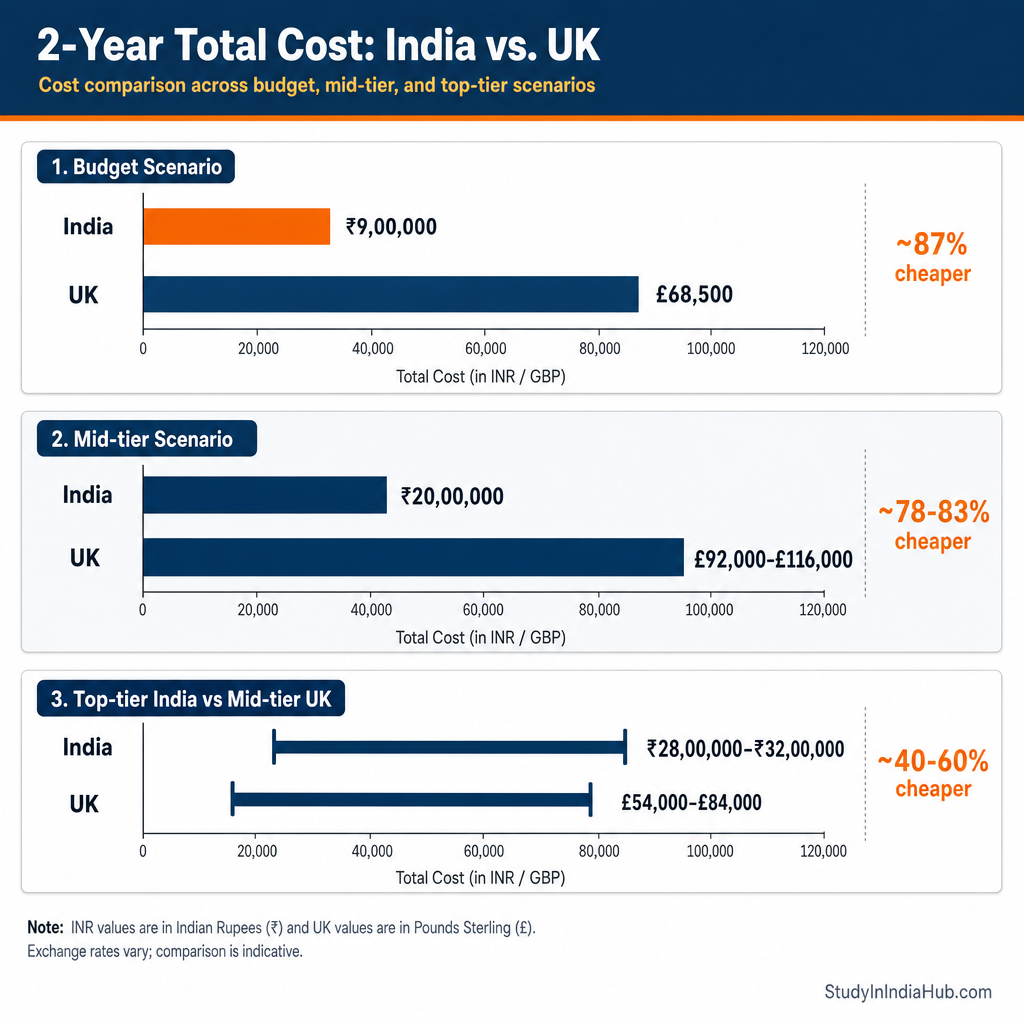
| Budget (mid-tier + modest living) | ₹9,00,000 (~£9,000) | ~£68,500 | ~87% cheaper |
| Mid-tier (e.g., Symbiosis MBA + city living) | ₹20,00,000 (~£20,000) | ~£92,000–£116,000 | ~78–83% cheaper |
| Top-tier India vs. mid-tier UK | ₹28,00,000–₹32,00,000 (~£28,000–£32,000) | ~£54,000–£84,000 | ~40–60% cheaper |
The living expenses in the UK over a span of two years total £24,000–£48,000 (Numbeo UK). That’s prior to any tuition payment. India's range during the same timeframe: ₹2,40,000–₹7,20,000 (~£2,400–£7,200).
[Image placeholder: Bar chart comparing 2-year total program cost in India vs UK across three tiers.]
Where the Gap Narrows
Leading Indian programs cost ₹6,00,000–₹16,00,000 annually, such as Symbiosis MBA, FLAME, or elite tracks at Delhi University. A mid-range UK postgraduate course (non-Russell Group) costs £15,000–£18,000 annually in tuition fees (UCAS). India continues to win by 40–60%. However, the total difference decreases from six-digit numbers to approximately £20,000–£40,000.
Costs Students Routinely Miss
- Health insurance: ₹15,000–₹30,000 annually in India.- E-FRRO registration: required within 14 days of getting to India (Study in India Portal)- Employment Visa criteria after studies in India: salary must be at least ₹16.25 lakhs (~$25,000 USD) (CGI San Francisco). That sets a tough standard for new graduates.- Fees for exams, materials for courses, and travel expenses home, allocate these individually. Consistently evaluate tuition + 12 months of living expenses + visa fee as a single figure.
Academic Quality and University Rankings
Expense constitutes fifty percent of the formula. What you receive for that expense is the remaining portion. The UK features a higher number of universities in the global top 100 within QS and THE rankings. That portion is accurate. However, placing "India" and "UK" in the same ranking categories is where students incur costly errors. A UK university ranked 80–150 globally does not guarantee an advantage over an IIT or IIM in your particular field.

Placement data conveys a clearer narrative. The Placement Report 2024 from IIM Ahmedabad indicates that every member of the graduating cohort received offers during campus placements. Average CTC: ₹34.36 LPA. The Class of 2024 report from ISB noted a median salary of ₹34.20 LPA with job offers made to the entire cohort. Institutions affiliated with SPPU reported placement rates between 85–92% for their top engineering and management programs in 2024–25, offering average packages of ₹6–8 LPA.The premier Indian institutions are exceptional in their specific fields. IITs directly rival leading UK engineering universities in terms of employer acknowledgment. At the IIMs and Indian School of Business (ISB), placement rates are nearly 100% within 3 months in most years. That outcome data is not reflected in global ranking systems, which place significant emphasis on research productivity and the proportion of international faculty. The metrics advantage UK institutions structurally, rather than academically. Apart from the IITs and IIMs, expertise in specific subjects is crucial. Indian Statistical Institute (ISI) Kolkata and Jadavpur University hold genuine international esteem in their domains. These names will not be found in the global top 200. However, in statistics or engineering, the depth of their faculty and the acknowledgment from employers are genuine.
| Quality Factor | India's Strength | UK's Strength |
|---|---|---|
| Elite Specialization | IITs (Engineering), IIMs/ISB (Management), ISI (Statistics) | Broad excellence — Oxbridge, Imperial, UCL |
| Graduate Employability | Near-100% placement at top IIMs/ISB within 3 months (collegesearch.in); strong placement cells | Strong global brand in finance, consulting, research |
| Research & Global Rank | Concentrated in a few elite institutes; fewer in global top 200 | More universities in top 100; higher average research output |
| Cost-to-Quality Ratio | Top-50 global MBA at an IIM: ₹15–25 lakh total | Comparable UK program: £25,000–45,000 per year |
According to NEP 2020, the leading 100 international universities are permitted to establish campuses in India. That indicates a changing competitive environment. Confirm institutional status immediately prior to making a decision.The effective filter: obtain the QS or THE ranking for your particular program. Next, verify employer acknowledgment in your desired job market. A student aiming for tech positions in Bangalore will notice IIT alumni are held in higher regard than a mid-tier UK graduate. A student aiming for finance in London will encounter the opposite.
Work Rights During and After Your Degree
| Aspect | United Kingdom | India |
|---|---|---|
| During Study | 20 hrs/week in term time; full-time in holidays (UK Government) | No standardized hourly cap published in official sources |
| Post-Study Work | Graduate Route: 2 years (3 years for PhD); no job offer or sponsor required (UK Government) | No standard post-study work visa; must convert to Employment Visa with a sponsor (Bureau of Immigration) |
| Salary Threshold | None on Graduate Route | Minimum ~₹16.25 lakh/year (~USD $25,000) to qualify for Employment Visa (CGI San Francisco) |
The UK Graduate Route stands out as the most significant post-study differentiator. It provides 2 years (3 for PhDs) for work without sponsorship, allowing time to change jobs, gain UK experience, or obtain a Skilled Worker Visa. That's 24 months of income and professional growth that directly influences your degree's return on investment. From our interactions with UK applicants, admissions teams highlight two truths. Transforming that temporary permit into a permanent Skilled Worker visa is where many students struggle. Graduates at the mid-tier level from outside London generally require positions that offer a salary of no less than £38,700 (the threshold for 2025). Employers are required to pay Certificate of Sponsorship fees along with the Immigration Skills Charge of £1,000 annually for medium and large sponsors. Numerous smaller companies discreetly steer clear of that expense. Students who choose their field (healthcare, tech, engineering) before arriving experience a higher conversion rate compared to those who make their decisions after graduation. India's route is distinct. There is no automatic visa for work after studies. The Employment Visa process is initiated by the employer, not by you. The job opportunity with the qualifying salary must be secured before your student visa runs out. Even capable students encounter a limited timeframe if they haven't secured a sponsor prior to graduation. A compliance requirement for India: if your Student Visa is valid for over 180 days, you must register with the FRRO within 14 days of your arrival (DocuPro). Not having this results in paperwork issues at an inconvenient time.
ROI: Which Degree Pays Off Faster?
ROI depends on three factors: overall expenditure, initial salary in your desired market, and duration to recoup costs. The figure displayed on the website is never the ultimate figure. Through our collaboration with UK Graduate Route students, a clear trend appears. Securing a first skilled position typically requires approximately 4 to 7 months after graduation. Initial salaries typically range from £28,000 to £34,000 outside of London. In the second year, numerous individuals transition to Skilled Worker sponsorship, with salaries increasing to £38,000–£45,000 in technology, finance, and healthcare. The unsponsored window of two years is what enables the ROI to function.
Two Concrete Scenarios
| Scenario | Total Program Cost | Target Market | Avg. Starting Salary | Break-Even |
|---|---|---|---|---|
| Indian MBA (SIBM Pune / NMIMS) | ₹17–23 lakhs | India / Asia | ₹10–15 lakhs/year | 18–30 months |
| LPU two-year MBA | ₹9–11 lakhs | India / Asia | ₹8–12 lakhs/year | 12–18 months |
| ISB Hyderabad MBA | ₹35–37 lakhs | India / Global | ₹20–25 lakhs/year | 18–24 months |
| UK mid-tier MBA | £25,000–£35,000 (~₹26–36 lakhs) | UK / Europe | £28,000–£45,000/year | 24–36 months |
Scenario 1, Indian MBA, Asia-focused career. A learner at NMIMS, XLRI, or SIBM invests ₹17–23 lakhs overall. In a Mumbai or Bangalore position at ₹12–15 lakhs, the break-even point is achieved in 18–30 months. No visa complications. No moving expenses diminishing first-year profits. The integration of ICCR + merit funding has subsidized up to 90% of MBA fees at schools such as Symbiosis for qualifying international students.Scenario 2, UK mid-range MBA, European or worldwide career. Total expenses amount to £25,000–£35,000. A graduate position in London with a salary of £28,000–£35,000 appears to be similar to those in India. However, visa sponsorship expenses for employers amount to £719 annually: a sum that numerous mid-market companies include in their proposals. Moving costs an additional £2,000–£5,000. Break-even period extends to 24–36 months. By the fourth or fifth year, though, a UK salary range of £45,000–£65,000 surpasses what the same graduate would receive in India.
The Decision Rule
- Select India if your prospective employers are in India, Southeast Asia, or the Gulf. Reduced fees, quicker profitability, no currency exposure on repayments.- Select the UK if your desired employers are in Europe or international companies offering payments in sterling or euros. The increased initial expense can be recuperated, but solely if you succeed in obtaining that market-rate proposal.- Calculate based on your personal offer letter, not the tuition section.
Scholarships and Funding Available in Each Country
India's scholarship market is not as large as the headlines imply. However, substantial earnings are achievable if you align the correct program with your nation and proficiency level.

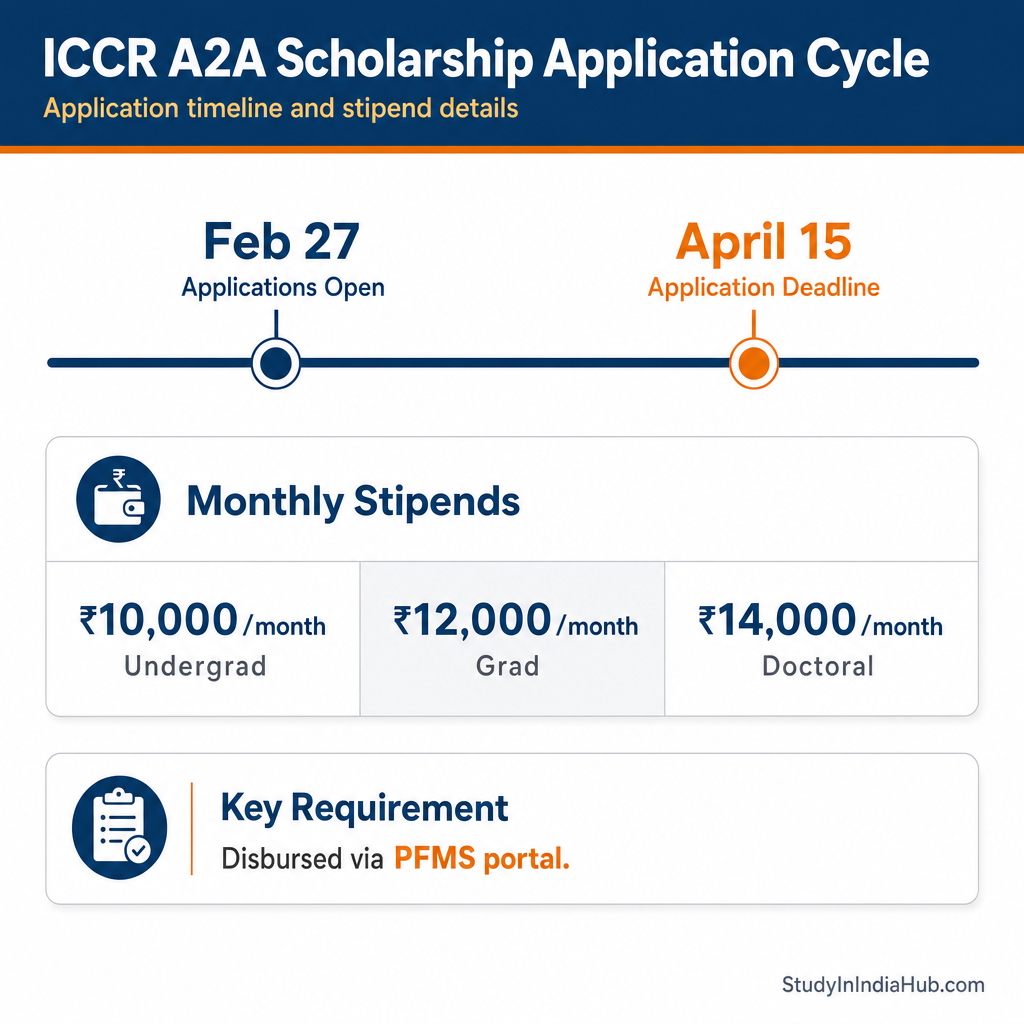
For the 2026–27 period, ICCR has designated approximately 3,800 scholarship positions worldwide under its General Scholarship Scheme. Individual Indian missions publish country quotas. Sri Lanka was allocated 270 slots. Afghanistan received 1,000. Nepal obtained approximately 180. Selection ratios range from 15% to 25% based on the stream and the country. Always verify the final slot numbers on your local mission site.ICCR A2A Scholarship is the biggest option supported by the government. Applications for 2026–27 were open from 27 February to 15 April 2026 (CGI Chicago). If you miss that timeframe, you forfeit an entire year of funding. Monthly stipends are disbursed via the PFMS portal:- ₹10,000/mes, estudiantes de pregrado- ₹12,000/month, graduates- ₹14,000/month, doctoral candidatesThese account for living expenses in many Indian cities, excluding tuition. Students who combine ICCR funding with a university merit scholarship receive optimal support.
| Scholarship | Target Region | Slots / Benefit |
|---|---|---|
| ICCR A2A | Nepal, Bangladesh, Sri Lanka, UAE, Kuwait, Africa, Middle East | Competitive; ~200 slots for Sri Lanka alone |
| Atal Bihari Vajpayee General Scholarship | Global | ~640 slots (IndEmbassyDili) |
| Sushma Swaraj Silver Jubilee Scholarship | Nepal | 100 slots (IndEmbKathmandu) |
| Colombo Plan Technical Scheme | Sri Lanka / SE Asia | 50 training opportunities |
| SAARC Quota | Bangladesh, Nepal | Reduced fees at central universities |
Competitiveness is the key factor. In the 2026–27 cycle, around 4,000 Sri Lankan applicants sought 200 fully funded ICCR positions, resulting in approximately a 5% acceptance rate (Jaffna Monitor).
Which Country Should You Choose?
The correct answer hinges on your financial situation, career goals, home nation, and if you require a post-study immigration option. Here is the framework for decision-making.
| Your Profile | Recommended Country | Primary Reason |
|---|---|---|
| Budget-Constrained | India | Tuition 60–80% lower; minimal debt possible |
| South/Southeast Asian | India | Faster visa processing, familiar documents, cultural proximity |
| Global Corporate Career | UK | Brand recognition in Western recruitment |
| Post-Study Immigration | UK | Established Graduate Route; unsponsored 2-year work permit |
Students with limited budgets (under $15,000 total): India is the obvious choice. Monthly grocery expenses in Hyderabad range from ₹2,500–₹4,000 (Numbeo). By combining ICCR scholarships with institutional merit aid, a nearly free MBA can be achieved.Learners from South or Southeast Asia: India possesses inherent benefits. Sri Lanka is positioned 5th among countries providing international students to India (LPU). Admissions teams are familiar with your documents. Visa processing occurs more swiftly. There is no currency surprise upon arrival.Students aiming for international employers in finance, consulting, or technology: The UK's academic reputation and direct access to graduate recruitment in London continue to be more robust. The Graduate Route offers a systematic pathway that India has not yet formalized. India ranks 4th in the QS World University Rankings 2026 based on country representation (Edmaster). The international acknowledgment gap is closing. However, in terms of careers in the Western market, the UK remains at the forefront.
Which has better job prospects after graduation?
Employment opportunities vary based on your desired location. The two nations provide fundamentally distinct routes.When your target market is India or South Asia, an Indian degree accelerates your entry into hiring processes. Campus recruitment at universities such as Symbiosis (SPPU) begins prior to graduation. The international centre at SPPU accommodates approximately 10,000 international students from more than 100 nations (SPPU International Centre). This establishes a dynamic placement environment with direct access for employers. A Bangladeshi student we monitored enrolled with an HSC qualification and financed 90% of MBA costs through ICCR along with merit scholarships. He secured a placement in Pune prior to his last semester.If your intended audience is the UK, Gulf, or Western employers, a degree from the UK is more advantageous. Those employers immediately acknowledge UK institutions. The UK also provides a defined period for post-study job searching. India lacks this.
| Feature | India | United Kingdom |
|---|---|---|
| Post-Study Work Window | None — visa expires at graduation | 2-year Graduate Route |
| Recruitment Style | Campus placements (pre-graduation) | Individual applications (post-graduation) |
| Registration on Arrival | E-FRRO within 14 days | BRP/Home Office tracking |
| Late Compliance Penalty | Late fee + status risk | Visa curtailment |
On the UK side, the Graduate Outcomes survey conducted by Jisc and covering all graduates 15 months post-completion provides the most comparable data. It reveals that 70% of international graduates are employed in some capacity, in contrast to 72% of UK graduates ([UKCISA](https://www.uk
Common Mistakes to Avoid
Excluding the security deposit (usually ₹25,000–₹50,000). Many students plan for tuition and housing costs but overlook the initial deposit required by landlords. Typically, it's 2–3 months of rent, returned when you move out. However, you require that money right from the start. Maintain an additional ₹50,000 cushion in your account prior to your arrival.If hostel is assured, apply promptly, as spots get occupied quickly. University hostel applications typically operate on a first-come, first-served basis. Numerous international students believe that being admitted guarantees housing. It does not. Submit your hostel placement application during the week you receive your offer letter. Research an alternative PG (paying guest) option beforehand. If you hold off until July, you’ll incur private rent at twice the price.Underrating expenses in areas beyond Mumbai and Pune. Bangalore, Delhi NCR, and Hyderabad have subtly matched and in certain localities, exceeded: Mumbai and Pune regarding rent and food (Numbeo Bangalore; Numbeo Delhi). Avoid depending on cost guides or YouTube videos from 2020. Examine the latest rental listings on NoBroker or MagicBricks for your designated region. Increase by 15–20% for inflation, as most online estimates are outdated.Failing to apply for scholarships prior to the deadline. Scholarship due dates typically occur 3–6 months ahead of the beginning of the academic term. That’s much earlier than when numerous students finalize their enrollment. Create a spreadsheet containing all scholarships you are eligible for, including ICCR, university awards, and state government programs, with deadlines prioritized first (ICCR). Submit applications to a minimum of five. Viewing scholarships as a secondary option is how students forfeit lakhs of rupees.
Frequently Asked Questions
Is it possible to pursue a medical degree in India at a lower cost than a management degree?Absolutely. At the University of Mumbai, the annual MBBS fee begins at ₹25,000. Their MBA courses cost ₹8,40,000 annually (Shiksha/Mumbai University). The most affordable option in all fields is a BA at Delhi University: ₹4,800–₹21,000 annually (DU Foreign Students Registry).
What hidden costs do universities not mention upfront?
In addition to tuition, set aside funds for a refundable security deposit (₹5,000–₹20,000), semester examination charges, and fees for student activities. Programs based in labs include costs for consumables and equipment. At Mumbai University, the tuition for international B. Tech programs ranges from ₹60,000 to ₹7,70,000 annually, not including additional fees.
How much buffer should I hold in liquid funds?
Set aside 15–20% of your overall yearly budget for unexpected travel or healthcare expenses (immitalks.com). If you find yourself low on funds during your program in India, your family can transfer money to your Indian bank account quickly. In the UK, the identical process is more gradual and faces increased examination from the Home Office.
Can I pay tuition in installments?
The majority of Indian public universities, such as SPPU, permit payments on a semester basis. The international MBA at SPPU costs ₹50,000–₹2,50,000 annually (Shiksha/SPPU). Certain European locations necessitate a compulsory €6,000 advance tuition fee prior to granting the visa. Verify the payment timeline with the finance office of the university prior to signing.
What are the proof-of-funds requirements for other popular destinations?
| Destination | Requirement |
|---|---|
| UK (London) | £1,529/month living costs (UK Government) |
| UK (outside London) | £1,171/month living costs (UK Government) |
| Canada | CA$22,895 living costs + first-year tuition (IRCC Canada) |
| Ireland | €6,000 tuition upfront |
In many Indian public universities, the cost for one year in Canada often surpasses the overall four-year expense.
What about health insurance?
In India, a regional health insurance plan costs ₹5,000–₹12,000 annually. It's required but seldom mentioned on university tuition websites. In the UK, as part of the visa application process, you are required to pay the Immigration Health Surcharge (IHS), which is a distinct one-time fee determined by the duration of the course.
Should I choose a university based on fees alone?
Negative. An ₹8,40,000 MBA from a reputable institution with excellent placement opportunities usually pays off quicker than a ₹42,600 program from a non-accredited college. The fee represents one variable. Employers examining your transcript prioritize placement rate, industry recognition, and NAAC/UGC accreditation.
How We Researched This Article
All articles undergo verification against original sources and are assessed by education experts who have firsthand experience in international student admissions. Our information is sourced from official university webpages, NAAC/NIRF records, government visa websites, Numbeo living expense statistics, and direct interactions with the university's international student offices. Currency exchange rates refreshed each day. Weekly updated living expenses. University information assessed every three months. All cost estimates utilize exchange rates averaged throughout Q3 2025 (1 GBP ≈ 105 INR, 1 USD ≈ 83 INR), obtained from RBI reference rates. Tuition and living expense information pertains to the 2025–26 academic year, with university fee adjustments confirmed from September to November 2025. In instances where institutions did not release the 2026 intake fees when this was written, we acknowledged this and utilized the latest verified figures.
Sources
- indiainatlanta.gov.in
- UCAS
- india-guide.in
- Study in India Portal
- Numbeo India
- Numbeo UK
- HCIPOM
- Ministry of Home Affairs – Employment Visa Annexure
- Consulate General of India, San Francisco – Employment Visa
- Indian School of Business (ISB)
- collegesearch.in
- NEP 2020
- UK Government – Student Visa
- UK Government – Graduate Visa
- Bureau of Immigration
- Gloroots
- DocuPro
- ICCR
- IndEmbassyDili
- IndEmbKathmandu
- Jaffna Monitor
- Numbeo – Bangalore
- Numbeo – Delhi
- LPU
- Edmaster
- SPPU International Centre
- [UKCISA](https://www.ukcisa.org.uk/news/what-do-the-latest-gra