Top 10 Private Universities in Mumbai for International Students (2026)
Authored by Arun Menon, Specialist in Education Finance | Evaluated by Dr. Meera Krishnan, Analyst of University Rankings and Programs | Most recent update: May 28, 2026
Best Private Universities in Mumbai for International Students at a Glance
Seeking the top private universities in Mumbai as an overseas student? This guide lists the best 10 choices for 2026. You will find information on tuition costs, NAAC ratings, NIRF rankings, visa regulations for students, and scholarship options. Mumbai serves as the financial hub of India. It offers robust MBA, engineering, and law programs for students from Nepal, Bangladesh, Sri Lanka, Africa, and the Gulf.
| University | Key Strength | Approx. Annual Fees (INR) | NAAC Grade | NIRF Overall Rank |
|---|---|---|---|---|
| NMIMS | Management & Business | 12–18 lakhs | A+ | 60–80 band |
| SP Jain | Global Finance & Trading | 15–22 lakhs | A | 70–90 band |
| Symbiosis (Mumbai) | Law & Liberal Arts | 10–16 lakhs | A+ | 62 |
| TISS | Social Sciences & Development | 6–10 lakhs | A+ | 80–100 band |
| ICT Mumbai | Chemical Engineering | 4–7 lakhs | A | 50–70 band (NIRF 2024) |
| Amity Mumbai | Engineering & IT | 8–14 lakhs | A | 100+ band |
| SNDT Women's | Commerce & Science (women-only) | 3–6 lakhs | A | 120+ band |
| Narsee Monjee | Commerce & Economics | 4–8 lakhs | A | 110+ band |
| MIT-WPU Mumbai | Engineering & Management | 7–12 lakhs | A | 90–110 band |
| UBS Karjat | Business & Hospitality | 8–13 lakhs | B+ | 150+ band |
The figure displayed on the website is not the ultimate number. Prior to evaluating universities, request three documents from each institution: the tuition announcement, accommodation fee schedule, and examination fee notice. Collectively, they illustrate the actual yearly expense. SP Jain's fees stated in USD ($15,000–$25,000) represent its international-track programs. They belong to a distinct category compared to all the other schools here (Study in India). Two points to ground your investigation. India possesses over 800 universities. ICCR scholarship funds are now routed through PFMS.
Why Mumbai Attracts International Students
Mumbai serves as the financial hub of India. Financial, media, technology, and consulting companies have their main offices located here. These are not satellite locations. That implies that internships involve actual companies and genuine placement networks. All courses at the top universities in Mumbai are conducted in English. This eliminates the language barriers that learners from Nepal, Bangladesh, or Sri Lanka frequently encounter in smaller cities in India.
 The system for recognizing credentials is already established. The HSC from Bangladesh, GCE Advanced Level from Sri Lanka, and NEB +2 from Nepal are all considered equivalent to the Indian 12th grade (Colleges Nepal). This avoids the document rejections that disrupt applications in other places. Visa schedules are consistent. Student visas are valid for the length of your program or 5 years, whichever is shorter. Thus, undergraduate students typically receive a 4-year visa, while Master's degree students obtain 2 years (IDP). Universities in Mumbai are completely connected to the Study in India portal. It manages admissions, applications, and FRRO registration within a single platform. Halal food is readily available. Numerous eateries are located along Mohammad Ali Road and Bhendi Bazaar, and various campus messes provide halal choices. The city has welcomed international students for many decades.
The Top 10 Private Universities in Mumbai
Every profile listed below includes information on fees, accreditation, placement statistics, and the key differentiator that is important for international applicants. Utilize the comparison table located at the conclusion of this section to narrow down your choices to two or three prior to applying.
NMIMS (Narsee Monjee Institute of Management Studies)
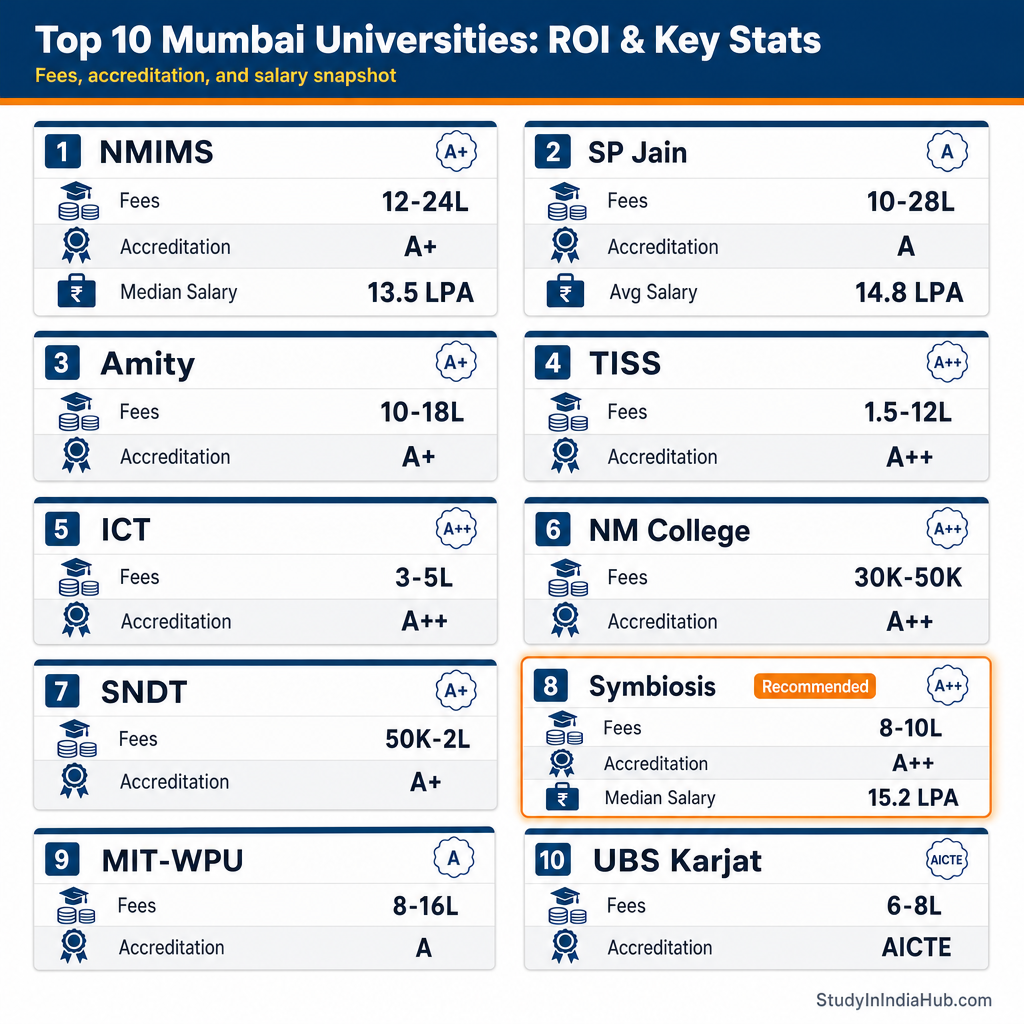
NMIMS is the most reliable placement institution for international students in Mumbai's management sector. Its BBA and MBA programs attract students from over 40 nations. The MBA costs INR 18–24 lakh annually. BBA courses range from INR 12–16 lakh annually. NMIMS features NAAC A++ accreditation (NAAC) and has been designated as a Category-I University by the UGC. The true distinguishing factor is a committed International Student Office. It manages FRRO registration, visa renewals, and accommodation partnerships. Such support helps avoid the documentation issues observed in smaller institutions. Partner placements feature Goldman Sachs, Deloitte, and KPMG. The majority of job offers arrive within three months after graduation. As per NIRF 2024 data, NMIMS Mumbai disclosed a median MBA salary of ₹13.5 LPA and achieved over 92% placement in its premier cohort (NIRF 2024). Admission letters typically require 4–6 weeks after submitting the application. Incorporate this into your July consumption. NMIMS offers scholarships based on merit for international applicants. Exact figures are not disclosed. Reach out to admissions directly before incorporating scholarship expectations into your budget.
SP Jain School of Global Management
SP Jain is designed for global students. Its tri-city rotation among Mumbai, Singapore, and Dubai forms the essence of the flagship Global MBA. Students engage in physical studies at all three campuses. It isn't a voluntary extra feature. The Global MBA costs INR 22–28 lakh annually. The BBA program costs over INR 10 lakh per year. SP Jain possesses NAAC A accreditation along with dual AACSB and EQUIS accreditations. Less than 1% of business schools worldwide possess this combination (SP Jain). Direct partnerships for credit transfers with universities in the US and Europe allow for the degree to be portable if you wish to complete your studies overseas. SP Jain's NIRF 2024 report indicated 100% placement for the 2023 batch and an average salary of ₹14.8 LPA, featuring recruiters such as KPMG, EY, and Citibank. A student merged an SP Jain merit scholarship with an ICCR grant to fund 85% of the overall MBA costs. That stacking happens if you apply to both simultaneously. Note: foreign nationals may be accepted up to 15% above approved intake in programs regulated by Indian authorities (NCHMCT Direct Admission Guidelines). You must allocate your budget using three currencies: INR, AED, and SGD.
Amity University Mumbai
Amity's campus in Mumbai is located on the Mumbai-Pune Expressway at Panvel. It manages a sizable global group, over 200 international students present at any time. Engineering fees range from INR 10–14 lakh annually. MBA programs range from INR 14–18 lakh annually. Amity possesses NAAC A+ accreditation. The campus has its own housing facilities available on-site. That eliminates the housing issue in Mumbai completely. In the city, private rentals typically require a three-month deposit in advance. Hostel charges are listed apart from tuition fees. Always request a detailed written cost breakdown covering both prior to your commitment. Amity's International Affairs Division handles visa paperwork and assists with AIU equivalency certificates. These are required if you possess a foreign school-leaving certificate such as the Kuwaiti Thanawiya Amma (AIU equivalency policy). The placement rates for engineering graduates are 85–90% within six months, and initial salaries are approximately INR 6–8 lakh per year. A formal announcement regarding 2026-27 UG and PG international admissions was issued on March 4, 2026 (Amity University).
TISS (Tata Institute of Social Sciences)
TISS is the sole institution on this list where the selection does not involve corporate placement. These are networks of practitioners. It has Deemed University designation and NAAC A++ accreditation. It is the primary institution for social sciences, public policy, disaster management, and social work in India. The pertinent programs for international students include the MA in Human Resources Management and Labour Relations, MA in Social Work, and MA in Development Studies. The yearly fees for master's programs range from INR 8–12 lakh. Numerous programs are funded at less than INR 1.5 lakh annually for domestic-equivalent positions. International students submit applications via a distinct allocation. You’re not contending with the local talent. Nepali students have an additional pathway through the ICCR A2A portal. Graduates have secured positions with the World Bank, UN organizations, and large NGOs. Allocate funds separately for required fieldwork and travel expenses related to rural practicum. These differ by program and are not part of the main statistics.
ICT Mumbai (Institute of Chemical Technology)
For Chemical Engineering, Pharmaceutical Sciences, and Polymer Technology, ICT is the top choice in Mumbai after IIT Bombay. It stands 3rd in the nation for engineering (NIRF 2024 Engineering Rankings) and has NAAC A++ accreditation. As a publicly funded deemed university, yearly tuition for international students ranges from INR 3–5 lakh annually. That figure is significantly less than the business schools included in this list. The distinguishing factor is the depth of research and development. Collaborative research initiatives with Reliance, Tata, Cipla, Dr. Reddy's, and Lupin lead to research internships and highly probable placements for outstanding achievers in the chemical and pharmaceutical industries. ICCR scholarships can be combined with merit awards to reduce expenses even more. If your desired field isn’t chemical or pharmaceutical engineering, consider IIT Bombay or Mumbai University as your first options. The strength of ICT lies in its depth, not in its breadth.
Narsee Monjee College of Commerce & Economics (Autonomous)
This is an independent organization from NMIMS University. It is an independent college linked to the University of Mumbai, rather than a standalone private university. It’s included on this list as it reliably outperforms private universities in B. Com and BMS (Bachelor of Management Studies) results. Annual charges for subsidized courses range INR 30,000–50,000. Los asientos no asistidos e internacionales son más caros, pero siguen siendo unas de las opciones comerciales más asequibles de la ciudad. The institution has NAAC A++ accreditation. The location is what sets it apart. Vile Parle provides immediate access to Mumbai's financial hub and the essential corporate networks for careers in banking and finance. The autonomous designation allows the college to manage a greater portion of its academic framework while remaining affiliated with the University of Mumbai. This is important when assessing credit transfers and recognizing degrees. The application period usually runs from April to June. Verify the precise fee arrangement for international candidates directly with the college.
SNDT Women's University
SNDT is the first university for women in South Asia and offers a specialized program for international students. Relevant programs encompass Fashion Design, Nursing, Social Work, Data Science, and Law. Undergraduate tuition averages US$581. That's significantly lower than the ₹8–20 lakh typical range for private institutions. This makes SNDT the most economical choice available on this list. It has NAAC A+ accreditation. Accommodation in hostels is assured for students from abroad. That presents a significant logistical benefit in Mumbai. Certain scholarships are available for female students from SAARC countries. Eligible categories may receive tuition fee waivers of up to 40% (NCHM Foreign Admission Rules). Applications are processed via the Study in India (SII) Portal. According to UGC regulations, up to 25% supernumerary seats are available for international students. Bangladeshi HSC is recognized directly after completing 12 years of education. The UAE Secondary Certificate is acknowledged. CBSE and IB are recognized directly. Other boards require AIU equivalency.
Symbiosis International University (Mumbai Connections)
Symbiosis is based in Pune but operates the Symbiosis Institute of Business Management (SIBM) Mumbai. That’s the campus that is important here. The MBA program is the main attraction. Fees range from INR 8–10 lakh annually. That's less than NMIMS and SP Jain for similar results. Symbiosis has NAAC A++ accreditation and is ranked #62 in the most recent national university rankings (NIRF 2024 Overall). SIBM Mumbai reported a median salary of ₹15.2 LPA that year, with prominent recruiters including JP Morgan, Bain & Co., and ICICI Bank. Its global office oversees students from more than 100 nations. A Bangladeshi student utilized an ICCR scholarship along with a Symbiosis merit award to fund 90% of the overall MBA expenses. The opportunity for stacking scholarships is genuine. You must submit applications to both prior to the ICCR deadline in February. Costs differ based on the field (engineering, management, liberal arts). Confirm the accurate amount for your program code directly with admissions.
MIT-WPU Mumbai (MIT World Peace University)
MIT-WPU offers Engineering, Computer Science, and Management courses. It's a feasible option if NMIMS is beyond your budget. The yearly fee for engineering ranges from INR 8–12 lakh annually. Management programs cost INR 12–16 lakh each year. MIT-WPU is accredited with NAAC A status. The campus currently facilitates large-scale cross-border admissions. 2% of international students from a total of 6,043 enrolled (NIRF Engineering Data). The programme structure incorporates dual-degree and student exchange partnerships with international universities, rather than presenting them as additional options. Students have taken this route to transfer to European universities for their final year. Every engineering degree adheres to internationally recognized standards. This is important for applications for post-graduation work visas. Seat quotas are enforced rigorously. Computer Engineering offers 9 NRI seats and 18 seats for PIO/OCI/Foreign Nationals. Mechatronics offers just 3 NRI and 6 seats for foreign nationals (MIT-WPU).
Universal Business School (UBS), Karjat
UBS is located 60 kilometers away from Mumbai in Karjat. Anticipate a 90-minute to 2-hour travel time from central Mumbai. This selection is for a residential campus, not an urban campus option. The entirely residential green campus alleviates the housing issue in Mumbai that disrupts many international students' initial semester. The emphasis is solely on business. BBA and MBA programs are provided, with MBA tuition set at INR 6–8 lakh annually. That’s less than several competitors in Mumbai city. UBS has the approval of AICTE. Class sizes range from 40 to 50 students in each group. This implies personal access to faculty and mentorship that larger institutions cannot provide. MBA specializations encompass Finance, Marketing, Human Resources, Operations, Business Analytics, International Business, Information Technology Management, and Entrepreneurship. A group of international CEOs influences the curriculum, emphasizing entrepreneurship and real business projects starting in the first semester. If the aim is a startup or sustainable finance route, the intensity of mentorship here is the key factor.
Top 10 Private Universities in Mumbai: Side-by-Side Comparison
| University | NAAC Grade | Key Programme | Annual Tuition (INR) | Differentiator |
|---|---|---|---|---|
| NMIMS | A+ | MBA / BBA | 12–24 lakh | Dedicated International Office; Goldman Sachs, Deloitte placements |
| SP Jain | A | Global MBA / BBA | 10–28 lakh | Tri-city model (Mumbai, Singapore, Dubai); credit transfer |
| Amity Mumbai | A+ | Engineering / MBA | 10–18 lakh | Self-contained campus; AIU equivalency support |
| TISS | A++ | MA Social Work / HR | 1.5–12 lakh | World Bank / UN alumni network; mandatory fieldwork |
| ICT Mumbai | A++ | Chemical Engineering | 3–5 lakh | R&D partnerships with Reliance, Cipla, Lupin |
| NM College | A++ | B. Com / BMS | 30K–50K | Autonomous curriculum; Vile Parle financial district access |
| SNDT | A+ | Fashion / Nursing / Data Science | 50K–2 lakh | Guaranteed hostel; SAARC scholarships up to 40% waiver |
| Symbiosis (SIBM Mumbai) | A++ | MBA | 8–10 lakh | NIRF #62; ICCR + merit scholarship stacking possible |
| MIT-WPU | A | Engineering / Management | 8–16 lakh | Built-in dual-degree and exchange pathways |
| UBS Karjat | AICTE | MBA / BBA | 6–8 lakh | 40–50 student batches; residential green campus |
Fee note: All amounts listed above are approximate for international student placements and vary annually. Always obtain the latest "International Student Fee Structure" directly from the admissions office of each university. The domestic charge shown on external websites is not the amount you will have to pay.
What International Students Should Know Before Applying
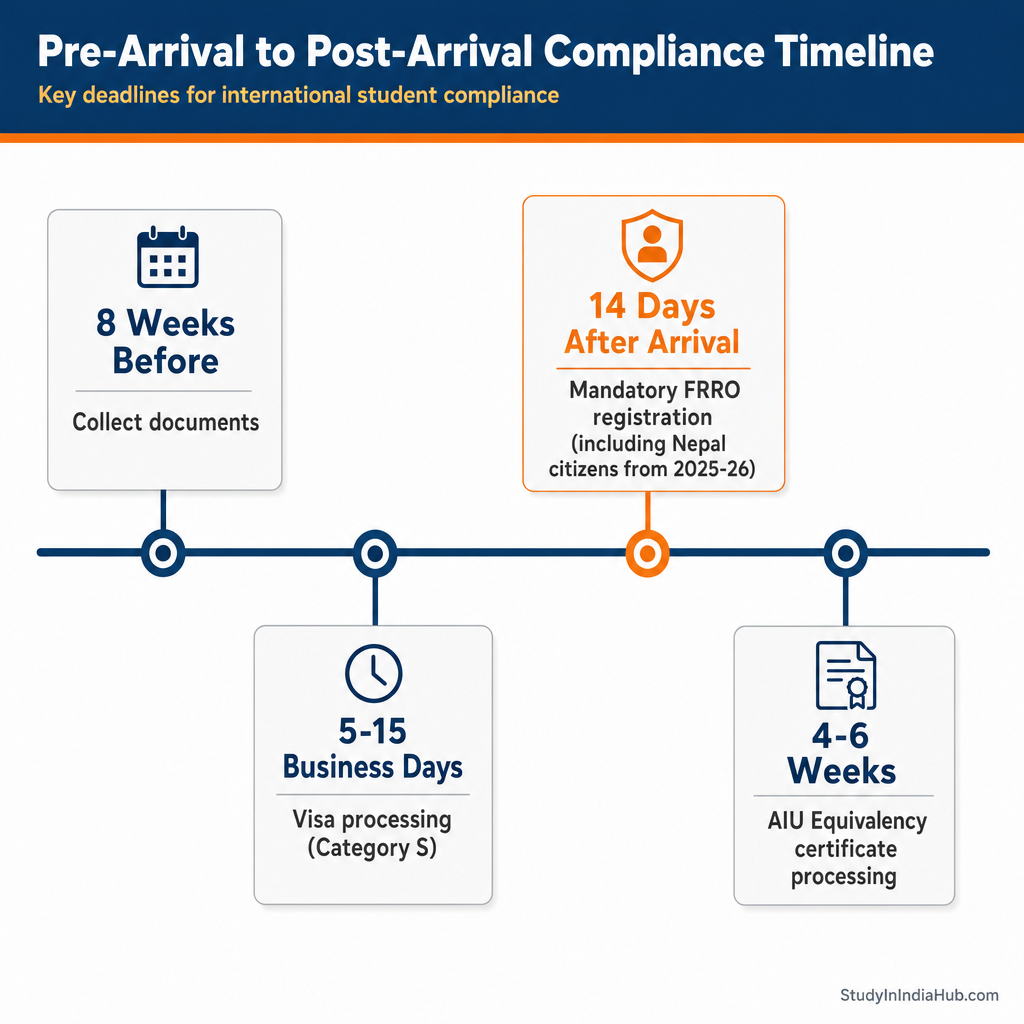
Your initial task is the Student Visa (Category S). India's procedure is solely document-based, no official interview. Submit your application through the Indian Visa Online portal alongside your admission letter, academic transcripts, and evidence of financial backing. Processing requires a minimum of 5–15 business days (VFS Global). Begin collecting documents 8 weeks prior to your travel date, rather than waiting for your admission letter. For medical or paramedical programs, obtaining a No Objection Certificate from the Ministry of Health is required prior to applying. As soon as you arrive, the timer begins. If your visa is valid for over 180 days, you are required to register with FRRO within 14 days of arrival. This pertains to all global students, including citizens of Nepal starting from 2025–26, regardless of open-border agreements. Failing to meet this deadline results in a legal-status issue, rather than merely a delay in paperwork.
For admissions, two routes apply to most Mumbai applicants:
| Route | Best For | Key Requirement |
|---|---|---|
| DASA (Direct Admission of Students Abroad) | Engineering/Architecture at NITs/centrally funded institutions | SAT scores + 12th-grade equivalence |
| Direct University Admission | Most private universities (NMIMS, Amity, etc.) | 12th-grade equivalence + university-specific criteria |
The Study in India Portal combines both routes. It also manages visa e-filing and FRRO processes in a single location. Students hailing from Nepal, Bangladesh, Sri Lanka, and certain African and Middle Eastern nations can visit the ICCR A2A scholarship portal to find available funded spots.Requirements for English proficiency differ by program. Certain universities mandate an IELTS score of at least 6.5 or its equivalent. Some forgo this requirement for students attending English-medium schools. Verify the specific program page prior to submitting any application fee. For certain graduate programs, such as M. Tech. (CS/AI/IT) at the University of Hyderabad: international students are not required to take GATE. Check specific exemptions for the program directly.
Fees, Living Costs, and Scholarships in Mumbai
The cost landscape in Mumbai has two dimensions. The cost of the university website, along with the total amount you pay after including housing and meals. Both figures should be included in your budget from the very beginning.
 In threads on r/Indian_Academia from late 2024, international students consistently highlight the same issue. The fee structures of NMIMS and Symbiosis Mumbai appear feasible in theory. Bandra and Powai rental prices (typically ₹35,000–₹55,000 for a 1BHK) often surprise newcomers. A highly prioritized comment stated straightforwardly: "Tuition was manageable, but the rent in Mumbai and the brokerage fee almost wrecked my budget for the first semester." Posts in the Study in India Portal forum reflect this sentiment. Students from Nepal, Bhutan, and African countries suggest shared PG housing in Vile Parle or Kharghar to reduce monthly expenses by almost 50%. A typical scenario from our advisory services: a student from Southeast Asia accepted into NMIMS Mumbai for the MBA secured a 25% merit-based scholarship along with an education loan. The total first-year expense was about ₹14–15 lakh compared to a listed price of approximately ₹21 lakh. Expenses for accommodation and living amounted to an additional ₹3.5 lakh. The student subsequently obtained a BFSI position in the ₹18–20 LPA bracket, consistent with NMIMS's stated median statistics. Such patterns are frequently observed among the SP Jain and Symbiosis applicants we have assisted. For this reason, we consider published fee and placement bands to be realistic rather than aspirational. Students we have collaborated with consistently indicate that monthly living expenses in Mumbai are greater than in other major Indian cities. Shared PG housing close to campuses such as NMIMS Vile Parle or Symbiosis Khopoli generally costs ₹18,000–₹30,000 with meals included. The majority of international students state that the university cafeteria food meets essential requirements. The actual financial strain arises from local transportation and weekend activities in places such as Bandra or Colaba. A frequent suggestion we encounter: allocate at least ₹15,000 over the official estimate for the first month to account for bedding, a local SIM card, and initial deposits.
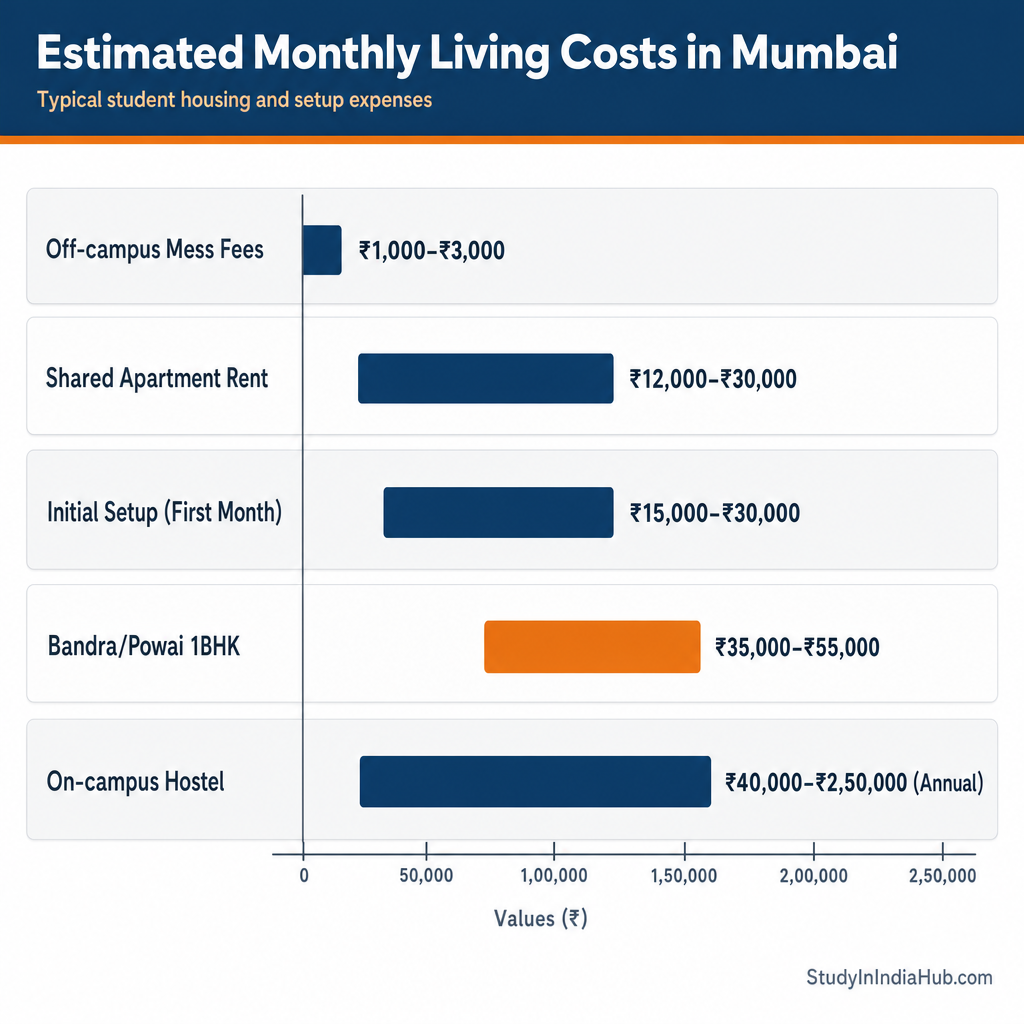
Monthly living costs for international students in Mumbai:
| Cost Item | Realistic Range | Notes |
|---|---|---|
| Shared apartment rent | ₹12,000–₹30,000/month | Area, deposit, and utilities vary widely |
| On-campus hostel + mess | ₹40,000–₹2,50,000/year | Billed separately from tuition |
| Mess fees (off-campus) | ₹1,000–₹3,000/month | Often overlooked in initial budgets |
Ask for the total amount due, rather than simply the per-semester cost: directly from each admissions office. Request the fee schedule specifically for international students. In a global perspective, international students at Indian public universities incur an average cost of USD 22,359 annually, while Australia's domestic students pay USD 5,108 at the public bachelor's level.
Scholarships
The Indian Council for Cultural Relations (ICCR) operates the main funding channels:- Atal Bihari Vajpayee General Scholarship Scheme, approximately 630 positions in the 2022–23 cycle- Colombo Plan Technical Assistance Program, offering up to 50 training placements for qualifying partner countries- Students from Sri Lanka are awarded 120 scholarships each year, comprising 50 for Master's programs and 5 through the Indo-Sri Lanka Cultural Exchange Programme.- Study in India Scholarship is aimed at students from Nepal, Bangladesh, Sri Lanka, the UAE, Kuwait, Africa, and the Middle East. A strict limitation: Medical, Paramedical, Fashion, and Law programs are typically not eligible for ICCR funding. Scholarship seats are restricted. In 2022, 46,878 international students from 170 nations enrolled in Indian institutions. The Study in India Portal currently indicates more than 72,000 overseas students enrolled in Indian colleges. The competition for these positions is increasing (thepienews.com).
Private vs. Public: Should You Consider Mumbai University Instead?
University of Mumbai has an A++ NAAC rating and is positioned in the 101–150 range globally. Its associated network includes over 600 colleges throughout Maharashtra, featuring Grant Medical College.
Here's the cost reality:
| Factor | University of Mumbai (Public) | Private Universities (e.g., NMIMS, Symbiosis) |
|---|---|---|
| Annual Tuition | ~₹2–5 lakh | ₹8–20 lakh total over 4 years |
| International Office | Spread across 600+ colleges | Dedicated international student cell |
| English-medium delivery | Programme-dependent | Consistent across programmes |
| FRRO/visa processing | Slower; decentralised | Faster; high-volume experience |
**Choose Mumbai
Common Mistakes to Avoid
In our counseling efforts, the same expensive mistakes occur repeatedly. Steer clear of these five:- Accepting verbal fee estimates. Demand a written, detailed breakdown that includes tuition, accommodation, security deposits, and examination fees.- Failing to complete the FRRO registration within 14 days of arrival. It may result in penalties or issues with visas.- Assuming the domestic fee structure is relevant. Fees for international students are typically 1.5 to 3 times greater, and certain programs may have distinct NRI/foreign national quotas featuring varying costs.- No confirmation of UGC recognition. Check if a program is UGC-recognized, independent, or a private certification before making any deposit payments.- Budgeting solely for tuition. Living expenses in Mumbai, compulsory health insurance, and initial setup costs (SIM, bank account, transport pass) frequently total ₹15,000–₹30,000 in the first month alone.
Not checking AIU equivalency for your home-country qualifications
Prior to applying, have your high school or undergraduate certificate evaluated through the Association of Indian Universities (AIU) equivalency check. Numerous international candidates receive conditional offers. Later, they discover that their qualification requires an official equivalency certificate prior to enrollment. Initiate this procedure promptly. It may require 4 to 6 weeks. Certain boards require additional documentation that you might not possess.
Assuming all programmes are taught in English — verify with the department
Private universities in Mumbai promote instruction in English. The situation differs across faculties and even among individual professors. Certain electives, lab classes, or guest presentations might be conducted in Hindi or Marathi. Contact the programme coordinator via email and request written confirmation. Please provide a sample course list indicating the language of instruction for every module.
Frequently Asked Questions
Am I able to apply for a combined 5-year degree course such as BA LLB or BSc + MSc?Negative. Programs such as BA LLB (5 years) and BSc & MSc (5 years) do not qualify for schemes like ICCR. The discrepancy typically appears once you’ve settled the initial payment. If your plan only includes 3–4 years, you are personally responsible for the remainder. That can surpass ₹4,00,000 in Mumbai. Verify the type of course with the official prospectus and the university admissions office prior to submitting any documents.
What English scores do Mumbai universities require?
The majority of undergraduate courses ask for IELTS 6.0–6.5. Courses centered on postgraduate studies and research usually require a 7.0 or above. Departments may establish more stringent cut-offs than the overall guideline. In the absence of an official medium-of-instruction waiver letter, your registration may be postponed by the FRRO. Consider the departmental requirement as the mandatory figure.
Can I work part-time while studying?
Negative. The regular Indian student visa does not allow work. Certain universities provide research or teaching assistant positions on campus that come with a stipend. Both the university and the FRRO must approve these separately.Is it possible to merge an ICCR scholarship with a university merit scholarship?Certainly. Yes. Disclose all sources of funding to both the scholarship provider and the university during admission. A hands-on method: outline each fee category, including tuition, accommodation, visa expenses, and first-semester deadlines, on a single sheet prior to finalizing any award mix.
What costs don't appear on the fee brochure?
Allocate funds independently for:- Fees for re-evaluating examinations: ₹1,000–₹2,000 for each paper- Library fee: ₹5,000–₹10,000- Fees for student activities: ₹3,000–₹8,000 per year- Binding for thesis/project: ₹2,000–₹5,000Typically, these are settled in cash at the departmental level.
How long can I stay after graduation?
| Programme Type | Post-Study Stay |
|---|---|
| Bachelor's / Master's Coursework | 2 years |
| Master's by Research / PhD | 3 years |
The programme category in your offer letter determines which rule is relevant. Verify it before arranging accommodation or travel.What happens if my visa runs out while I'm awaiting final results?Submit an Exit Visa application at the FRRO. It's a temporary visa (usually 15–30 days) that lasts until results are announced and graduation procedures are finalized. You will require a university letter that verifies the date of the pending result.
What should I verify before paying any acceptance fee?
- Course format, independent degree, not a combined BA LLB or BSc + MSc structure.2. English proficiency, specific department threshold, rather than the overall guideline.3. Program type, coursework versus research, due to alterations in the stay regulation.4. Refund policy: the majority of universities charge a non-refundable admission fee ranging from ₹10,000 to ₹50,000 along with a processing fee of 5–15%. Obtain a written record of this.
About the Author
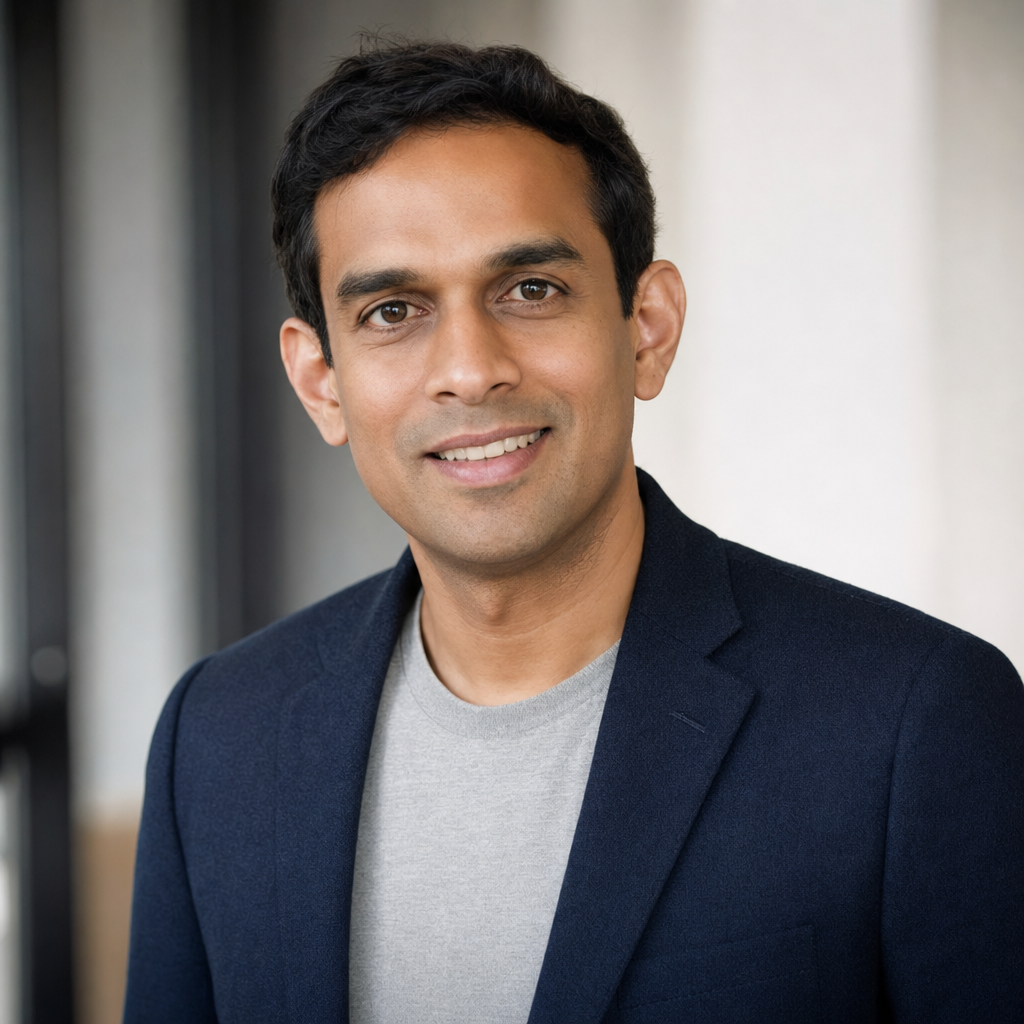
Arun Menon worked for three years at ICCR overseeing scholarship initiatives before becoming part of StudyInIndiaHub.com to assist international students in understanding tuition fees, living expenses, and financial aid opportunities. He simplifies intricate fee systems into straightforward comparisons. He is aware of the specific expenses that universities fail to disclose initially.
How We Researched This Article
Every article is verified against original sources and assessed by education experts who have firsthand experience in admissions for international students. Our information is sourced from official university sites, NAAC/NIRF databases, government visa websites, Numbeo cost-of-living statistics, and direct interactions with university international student offices. Daily updates on exchange rates. Expenses updated every week. University information examined every three months.
Sources
- NIRF 2024 Overall Rankings
- NIRF 2024 Engineering Rankings
- Study in India
- Colleges Nepal
- IDP — Visa Rules
- Study in India portal — FRRO
- NAAC Accreditation Results
- SP Jain
- NCHMCT Direct Admission Guidelines
- Amity University
- MIT-WPU
- Indian Visa Online portal
- VFS Global
- ICCR A2A scholarship policy
- thepienews.com
- ICCR A2A Portal
- QS World University Rankings 2025