Cheapest Countries to Study Abroad: Global University Fee Comparison (2026)
Authored by Arun Menon, Education Finance Expert | Evaluated by Dr. Meera Krishnan, University Rankings and Program Analyst | Most recent update: May 27, 2026Searching for the most affordable countries for studying abroad in 2026? This manual contrasts tuition expenses, living expenses, visa regulations, and employment rights among affordable places such as India, Germany, Malaysia, Poland, and Hungary. You'll discover where your funds stretch the most and where "free tuition" conceals actual expenses.
[IMAGE PLACEHOLDER: World map highlighting the top 10 cheapest study destinations with average annual tuition costs overlaid]
The cheapest countries to study abroad at a glance
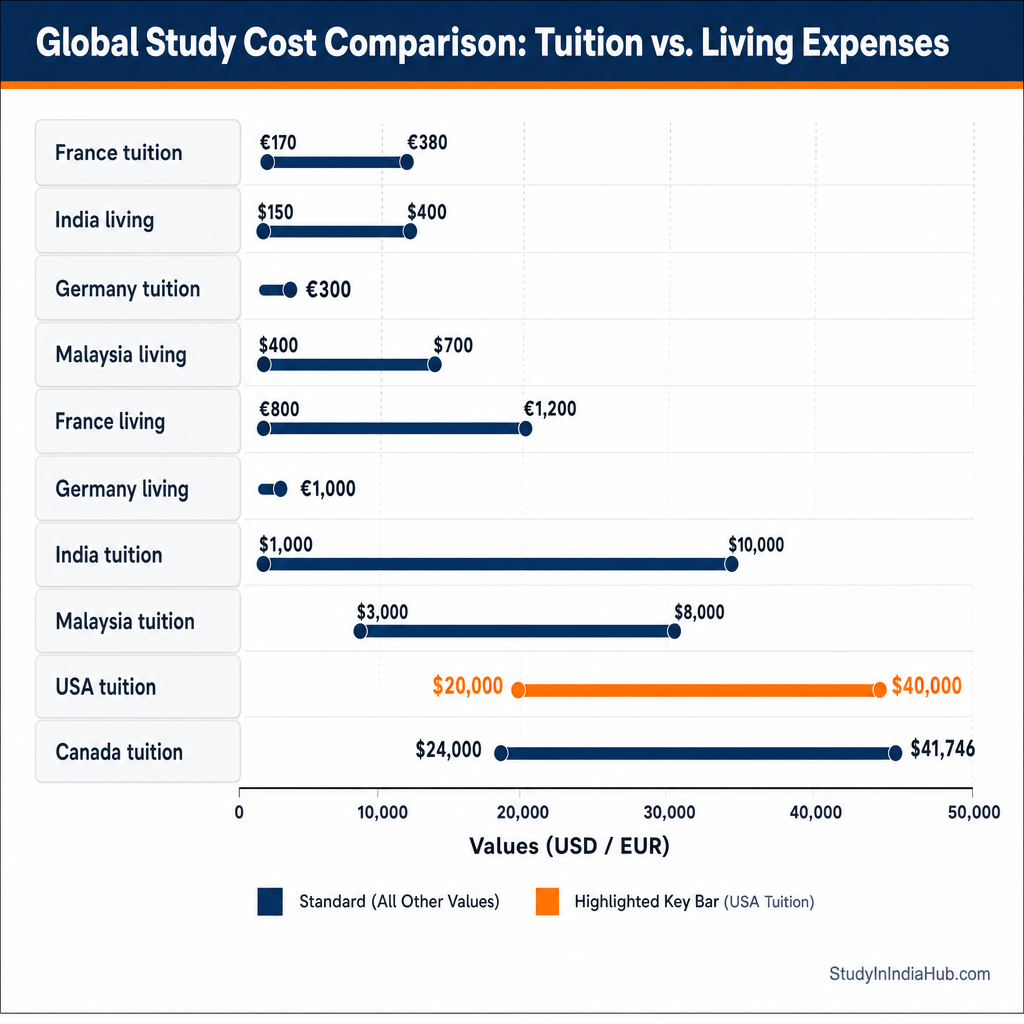
| Rank | Country | Approx. Annual Tuition (USD) | Monthly Living Cost (USD) | Key Advantage |
|---|---|---|---|---|
| 1 | India | $1,000 – $10,000 | $150 – $400 | Roughly 1/4 the cost of Western alternatives |
| 2 | Nepal | $1,500 – $5,000 | $200 – $350 | SAARC quota access at Indian universities |
| 3 | Bangladesh | $1,500 – $6,000 | $150 – $300 | SAARC quota access at Indian universities |
| 4 | Malaysia | $3,000 – $8,000 | $400 – $700 | English-medium programs, low cost of living |
| 5 | Turkey | $3,000 – $9,000 | $400 – $600 | Government scholarships on offer |
| 6 | Argentina | $1,000 – $5,000 | $300 – $500 | Public universities largely tuition-free |
| 7 | South Africa | $3,000 – $8,000 | $400 – $650 | Anglophone, recognized degrees |
| 8 | Sri Lanka | $1,500 – $5,000 | $200 – $350 | Low living costs, regional proximity |
| 9 | Australia | ~$24,000 | ~$1,400 | Work rights up to 48 hrs/fortnight |
Higher-cost benchmarks for context
The leading Western academic centers are significantly more expensive.- United States, Master's programs cost approximately $20,000–$40,000 annually.- Canada, the average undergraduate tuition is CAD $41,746 annually. Master's programs typically cost around CAD $24,000 annually (Statistics Canada).- Australia, Bachelor's programs cost between AUD $20,000 and $45,000 annually. Master's programs cost AUD $22,000–$50,000 annually (Study Australia). This is why India and its neighboring countries, at about a quarter of the Western price, consistently lead in affordability rankings.
Countries where tuition is free or near-zero
Germany currently offers the most authentic low-cost study options in Europe. Approximately 90% of all study programs are offered by public universities (MyGermanUniversity). They impose approximately €300/year for semester fees, which includes administration costs and generally a transit pass (DAAD). Baden-Württemberg imposes an additional €1,500/semester charge for students from non-EU countries. Expenses for living average around €1,000/month (Numbeo). You will have to demonstrate this in advance through a blocked account. You can labor 120 complete days or 240 partial days annually to balance expenses (Make it in Germany). The genuine barrier is language. The majority of bachelor's programs necessitate German proficiency at B2/C1 level (Uni Potsdam). Programs for master's degrees taught in English are increasing, with roughly a quarter now entirely in English; however, they still represent the minority.Norway remained free until 2023. The administration implemented tuition fees for students from outside the EU/EEA starting autumn 2023. For 2026 planning, Norway is no longer genuinely accessible for the majority of international applicants. The cost of living ranks among the highest in Europe at €1,000–€1,800/month.France maintains low tuition fees at public universities, approximately €170–€380 annually for a bachelor's degree. The cost of living differs significantly from one city to another. Paris costs €1,200/month or more. Other cities are priced around €800–€1,000/month. La plupart des programmes de premier cycle sont dispensés en français (niveau B2 requis). Options in English primarily exist at the master's level for business and engineering.
| Country | Tuition (Annual) | Living Cost (Monthly) | Language | Work Rights |
|---|---|---|---|---|
| Germany | ~€300 | ~€1,000 | B2/C1 German for most bachelor's | 120 full / 240 half days/year |
| Norway | Fees now apply for non-EU/EEA | €1,000–€1,800 | Norwegian; English at master's | ~20 hrs/week |
| France | €170–€380 | €800–€1,200 | B2 French for most bachelor's | ~964 hrs/year |
The straightforward summary: "free tuition" transfers the expenses to living costs, it doesn't remove them. If you do not currently fulfill the language requirement, consider the time and cost for language classes. That compromise is effective only if you are dedicated to the language, or if the alternative at home exceeds €10,000–€15,000/year.
Low-tuition, low-cost destinations in Asia
India, Malaysia, and Taiwan are the three places where both education and living expenses remain affordable simultaneously. Programs taught in English are prevalent here, not exceptions (Study in India).
[IMAGE PLACEHOLDER: Comparison infographic showing average annual tuition + living costs for India, Malaysia, and Taiwan vs. UK/Canada/Australia]
India
The typical yearly tuition is approximately ₹1,500/year at public colleges, which is lower than the amount most students spend on one semester in other places. The IITs and NITs are considered some of the leading institutions in Asia (IndoGlobal). Under the NEP 2020 guideline, the leading 100 international universities can establish campuses in India, broadening the availability of English-taught programs at local rates.The city selection influences your budget more significantly than the university selection. Mumbai and Pune are the two primary locations for international students:
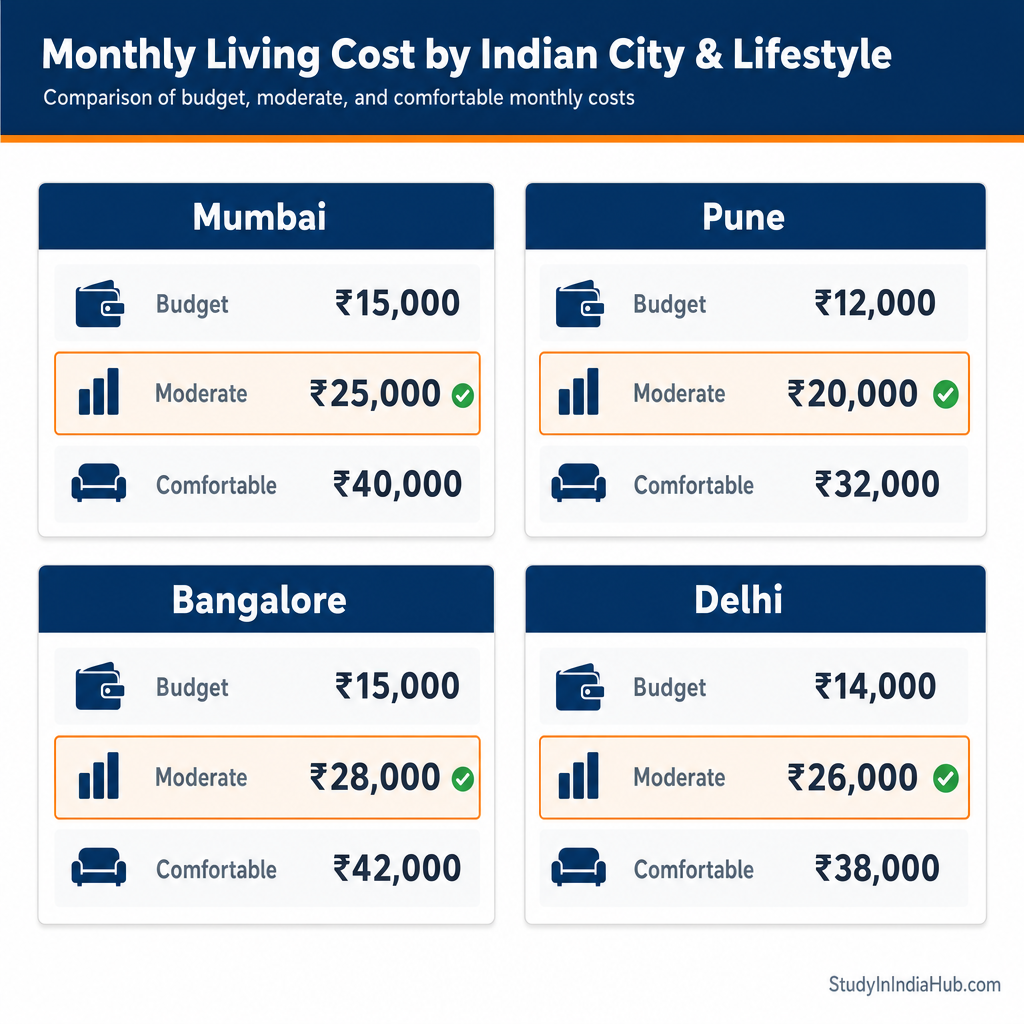
| City | Budget (Monthly) | Moderate (Monthly) | Comfortable (Monthly) |
|---|---|---|---|
| Mumbai | ₹15,000 | ₹25,000 | ₹40,000 |
| Pune | ₹12,000 | ₹20,000 | ₹32,000 |
| Bangalore | ₹15,000 | ₹28,000 | ₹42,000 |
| Delhi | ₹14,000 | ₹26,000 | ₹38,000 |
Sources: Numbeo
A student in Pune can manage total yearly expenses, including tuition and living costs, for less than ₹3 lakhs (~$3,600). India's scholarship landscape enhances this. Leading business schools typically provide 10% to 80% tuition discounts, alongside regular 25% academic scholarships for new MBA candidates (CrackVerbal). With support from ICCR, students at institutions such as Symbiosis have received as much as 90% of their MBA tuition funded. On-campus hostel and mess charges vary between ₹40,000 and ₹2,50,000 per year. Mess charges range from ₹1,000 to ₹3,000 per month. Dining out increases that to ₹8,400–₹9,600/month (Wise). Private tiffin services in Bangalore cost ₹4,000–₹7,000/month. A complete academic year, including tuition and living expenses: totals between $8,500–$10,000 for the majority of international students (EdMaster). One compliance item to note: international students holding an S-1 visa that is valid for over 180 days are required to register with the Foreign Regional Registration Officer (FRRO) within 14 days of their arrival using the e-FRRO portal (MHA). Failing to meet this deadline results in penalties and visa complications.India employment rights: the strict limit. There is no guaranteed post-study work visa. To remain and work post-graduation, you need to change to an Employment Visa with a sponsoring company. The lowest salary is ₹16.25 lakh annually (~$25,000) (Gloroots). The most frequent denial we encounter involves graduates taking positions at Indian startups with ₹15–18 lakh salaries, which fall below the threshold once converted. Candidates are often turned down when the position falls under "skills readily available in India," a stipulation that MHA officials enforce rigorously for entry-level marketing, HR, and general management roles (Bureau of Immigration).
Malaysia
Tuition fees for programs taught in English range from €2,500 to €6,000 per year. Malaysia's private institutions and global branch campuses, such as those from the UK and Australia, offer Western-quality degrees at a significantly lower cost than in their home countries. Kuala Lumpur and Penang are the primary cities for students. Living expenses are higher than in Pune, yet significantly lower than in any Western capital.
Taiwan
Tuition fees resemble those in Malaysia, ranging from €2,500 to €6,000 annually for programs taught in English. Postgraduate engineering and IT courses are the most appealing attraction. Living expenses beyond central Taipei are affordable, and the government administers focused scholarship initiatives for students from Southeast Asia. Taiwan's value choice is particular: if your program focuses on STEM, the quality-to-price ratio is tough to beat.
| Country | Avg. Annual Tuition | Monthly Living (Moderate) | Key Advantage |
|---|---|---|---|
| India | ~₹1,500 | ₹20,000 – Pune | Lowest cost floor; deep scholarship ecosystem |
| Malaysia | €2,500–€6,000 | KL higher than Pune | English-medium infrastructure; branch campuses |
| Taiwan | €2,500–€6,000 | Affordable outside Taipei | Strong STEM programmes |
| UK (reference) | ~$22,000 (UCAS) | ~$1,300 | — |
| Canada (reference) | ~$20,000 | ~$1,200 | — |
Affordable options in Eastern Europe and Latin America
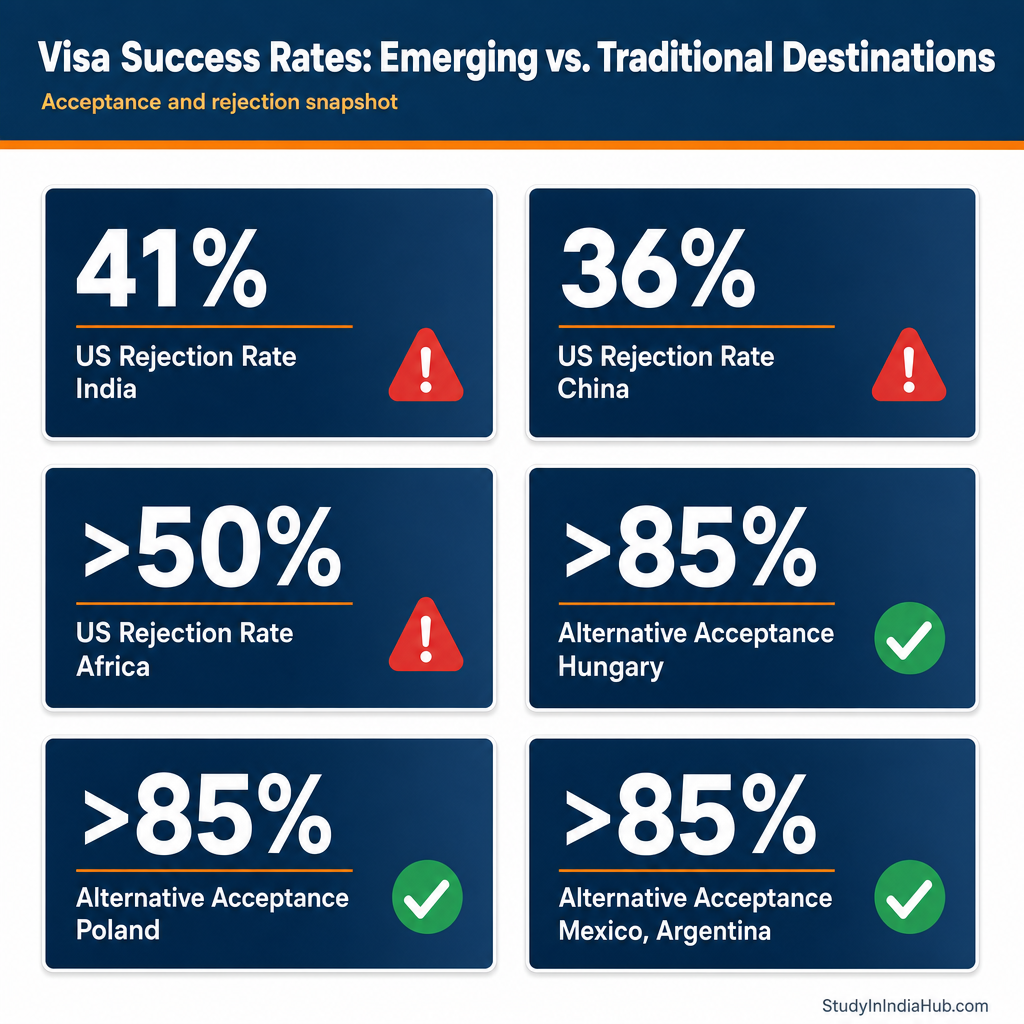
Poland, Hungary, and Mexico occupy a beneficial central position. While they may not be the lowest priced, each offers a degree in English without the costs typical of Western Europe or North America. In 2025, the rates of US visa refusals increased significantly. Indian applicants currently experience rejection rates close to 41%, Chinese applicants approximately 36%, while multiple African countries surpass 50% (Cato Institute). As US options diminish, an increasing number of families are looking to Hungary, Poland, Mexico, and Argentina, where higher education visa acceptance rates exceed 85% and annual tuition is kept below $5,000.
Poland
Programs taught in English at public universities usually range from €2,000 to €5,000 annually (Study in Poland). Allocate €600–€900/month for accommodation, meals, and transportation in Warsaw or Kraków. Working part-time while studying can significantly offset living expenses.
Hungary
Tuition fees for degrees taught in English range from €3,000 to €5,500 annually. Monthly expenses for living in Budapest range between €450–€800 (Study in Hungary). The Stipendium Hungaricum is the top choice, covering tuition entirely along with a monthly allowance. A degree with no out-of-pocket expenses is achievable for strong candidates.
Mexico
Tuition fees at public universities for international students may be less than $1,000 USD annually for programs taught in Spanish. MBA and engineering programs taught in English, primarily at private institutions, typically cost $3,000–$6,000 USD/year. Monthly living expenses near Mexico City range from $500–$700 USD.
| Country | Avg. Annual Tuition (English-taught) | Avg. Monthly Living Cost |
|---|---|---|
| Poland | €2,000–€5,000 | €600–€900 |
| Hungary | €3,000–€5,500 | €450–€800 |
| Mexico | $3,000–$6,000 USD | $500–$700 USD |
These markets are significant for students observing trends in US visa denials (MPOWER Financing).
Full cost comparison: tuition, living, visa, and work rights
| Country | Annual Tuition (Intl) | Monthly Living Cost | Visa Difficulty | Teaching Language | Part-Time Work? |
|---|---|---|---|---|---|
| India | $1,000–$10,000 | $200–$500 | Moderate | English/Hindi | No — campus only |
| Germany | €0–€18,000 | €800–€1,200 | Complex | German/English | 120 full days/year |
| France | €2,770–€3,770 | €600–€1,000 | Moderate | French/English | Part-time allowed |
| Finland | €4,000–€18,000 (Study in Finland) | €700–€1,100 | Moderate | Finnish/English | 30 hours/week |
| Sri Lanka | $3,500–$10,500 | $400–$600 | Moderate | English | Restricted |
The overall cost disparity for a four-year Bachelor's degree in Mechanical Engineering is significant:
| Destination | 4-Year Total |
|---|---|
| India (public universities) | ₹8–12 lakh |
| Malaysia | ₹22–28 lakh |
| Poland | ₹28–35 lakh |
| Canada | ₹85 lakh – 1.1 crore |
The tuition fees in Canada frequently surpass the total cost of a four-year package in Poland. Families often undervalue their living expenses by 30–40%, so rely on practical city-tier estimates instead of university brochure numbers. Indian institutions offer programs at approximately 25% of the cost of similar programs in other locations (EOI Vilnius).
Scholarships that cut costs even further
Four programs primarily determine what is realistically attainable for international students: ICCR (India), DAAD (Germany), Eiffel (France), and government initiatives in Malaysia and Taiwan.
[IMAGE PLACEHOLDER: Side-by-side comparison of top 4 scholarship programs — coverage, eligibility, deadlines, and acceptance rates]
Expenses that surprise individuals often do not show up in university pamphlets. A common comment on r/IndiaStudyAbroad states, "I wasn't informed that just the visa appointment costs ₹15,000 before tuition is even considered." Exam re-registration costs, biometric sessions, and police verification fees repeatedly emerge as hidden budget destroyers. For the 2026–27 period:The ICCR Africa-Asia scholarship attracted more than 4,000 applications for approximately 200 funded positions in Sri Lanka.- Stipendium Hungaricum is providing nearly 5,000 fully-funded positions in partner countries.- The competitive scholarships from DAAD have an acceptance rate of approximately 10–15%. Submit applications to two or three programs simultaneously; that's the practical approach.India's ICCR A2A Scholarship is the easiest fully funded option for individuals from South Asia, Africa, or the Middle East. The application period for 2026–27 was from February 27 to April 15, 2026 (CGI Chicago). That's about seven weeks, the complete yearly start. Fail to attend, and you'll forfeit an entire year. There is no ongoing enrollment.
Two smaller India schemes worth tracking:
- Atal Bihari Vajpayee General Scholarship Scheme, ~640 opportunities for 2025–26; ~630 opportunities in 2022–23 (Embassy of India, Kathmandu)- Silver Jubilee Scholarship Scheme by Sushma Swaraj, 100 positions in 2022–23Nepalese students ought to explore SAARC Scholarships. Countries qualifying for all ICCR tracks are Nepal, Bangladesh, Sri Lanka, UAE, Kuwait, Africa, and the Middle East (ICCR Policy Guidelines). In Sri Lanka alone, around 4,000 students vied for 200 fully funded positions in 2026–27 (Jaffna Monitor). If a scholarship covers just part of the fees, verify if your chosen university has supernumerary seats available for international students. That alters acceptance chances without modifying your educational background.
How to choose the right affordable destination for you
The most affordable destination on paper is effective only if it aligns with your language proficiency, degree acknowledgment, and future plans after studying. A student who pays €3,000/year in Prague and €800/month for rent experiences a completely different situation compared to another paying ₹2 lakh/year in Mumbai at ₹15,000/month.
Run every option through four filters in this order:
- Language ease, Czech state universities provide tuition-free education following a skills assessment. Programs taught in English there cost €2,000–€6,000 annually. Spending five years learning a language you can't use in social settings is a significant expense.2. Recognition of degree in your country, Verify if the licensing or employer organizations in your home country recognize the particular university, not merely the nation. Confirm before making any deposit.3. Job prospects post-graduation, A qualification from India's leading public institutions (₹6–14 lakh total for 4 years of engineering) holds considerable value throughout South Asia and the Middle East.4. Complete budget, not just tuition, include 12 months of living expenses + visa costs + one round-trip airfare. The number of the website is never the ultimate number. The place you're headed to isn't the least expensive option. It's the one you can pay for.
Common mistakes to avoid
Excluding the security deposit (typically ₹25,000–₹50,000)This surprises nearly every family. The deposit is typically required alongside your initial semester payments. Plan for it in advance instead of rushing later. Most universities return it after your course concludes, but do not rely on that money while studying.Presuming hostel is assuredHostel lodging is seldom guaranteed, even post-admission. Send in your hostel application as soon as your admission is verified. Rooms are typically distributed on a first-come, first-served principle. If you miss the deadline, you'll be searching for private PGs that are two to three times more expensive.Undervaluing expenses of living beyond Mumbai and PunePeople think that smaller cities are consistently inexpensive. University towns ranked as tier-2 can catch you off guard. While rent may be cheaper, transportation, food delivery, and few housing choices frequently raise monthly expenses towards metro prices. Engage with current students on campus forums prior to finalizing your budget.Failing to submit scholarship applications prior to the deadlineScholarship deadlines frequently occur prior to the release of admission results. That confuses the majority of candidates. Create a spreadsheet listing all scholarships you qualify for, their deadlines, required documents, and associated links. Initiate applications simultaneously with your university paperwork. Delaying until you've confirmed your admission often results in missing out on the best funding opportunities.
Frequently Asked Questions
Q: Is it possible to pursue studies in India for less than ₹50,000 annually?Indeed, but solely in particular programs. Delhi University's BA programs for international students cost ₹4,800–₹21,000 annually (DU Foreign Students Registry). For STEM, anticipate ₹40,000–₹1,80,000 at Pune University for BTech, and ₹60,000–₹7,70,000 at Mumbai University based on whether the institution is government-funded or private. Charges for exams, library deposits, and lab fees are included additionally.Q: What evidence of living expenses is required for a visa to the UK or Canada?- UK (London): £1,529/month (IDP)- UK (excluding London): £1,171/month- Canada: CA$22,895 per year in addition to first-year tuitionThese represent actual cash needs, rather than approximations. Include a 15–20% cushion for healthcare expenses or urgent travel (Immitalks). Students who regularly bypass this buffer often fall short by the second semester.Q: Is it necessary to pay tuition prior to getting my visa approved?In certain nations, affirmative. Ireland necessitates an upfront €6,000 tuition fee prior to the commencement of visa processing. This is not a deposit; the visa officer requires it to be cleared prior to granting approval. International bank transfers require 3–5 business days to process, resulting in students who don't withdraw funds in time missing their intake completely.Q: What happens if my scholarship pays for 60% and I can only demonstrate 40% myself?Record both. Visa officers evaluate the overall funds accessible, not solely the personal contribution. Provide your scholarship award letter together with your bank statements. If the scholarship letter comes after you've submitted your application, you might have to reapply or postpone. Ensure the scholarship documentation arrives prior to your visa application.
Q: Which Indian university has the widest fee range?
Mumbai University. MBBS costs ₹25,000–₹5,00,000 annually (University of Mumbai). MBA ranges from ₹42,600 to ₹8,40,000. Before finalizing your decision, inquire with admissions about the particular college within the university you will be attending. That one response dictates your true charge, rather than the stated range.Q: What is the method to evaluate a low-tuition nation versus a high-tuition nation that offers work rights?
Build a three-column comparison:
| Column | What to Enter |
|---|---|
| A — Total tuition | Full program cost |
| B — Living cost proof | Visa-mandated figures above |
| C — Part-time income | Legal work-hour limit × local minimum wage |
Net cost = (A + B) − C. A nation with elevated tuition fees but liberal work regulations may be less expensive than a country with no tuition but stringent work-hour limits.
About the Author
Arun Menon dedicated three years to managing scholarship programs at ICCR before moving to StudyInIndiaHub.com, where he assists international students with tuition fees, living expenses, and financing opportunities. He clarifies complicated fee structures into straightforward comparisons and understands precisely which expenses universities fail to disclose initially.
How we researched this article
Every article is verified against original sources and evaluated by education experts who have direct experience in the admissions of international students. Our information is sourced from official university websites, NAAC/NIRF databases, government visa portals, Numbeo cost-of-living statistics, and direct contact with university international student offices. Daily updates on exchange rates. Weekly updates on living expenses. Data from the university is examined every three months.
Sources
- Numbeo, India
- Numbeo, Germany
- Numbeo, Australia
- Numbeo, Mumbai
- Numbeo, Pune
- Numbeo — Bangalore
- Numbeo, Delhi
- DAAD
- Make it in Germany
- MyGermanUniversity
- Uni Potsdam
- Study Australia
- Study in India
- IndoGlobal
- Alfabeta Global
- CrackVerbal
- UCAS
- Statistics Canada
- Study in Poland
- Study in Hungary
- Cato Institute
- MPOWER Financing
- Study in Finland
- EdMaster
- Wise
- EOI Vilnius
- MHA
- Gloroots
- Bureau of Immigration
- CGI Chicago
- ICCR Policy Guidelines
- Jaffna Monitor
- Embassy of India, Kathmandu
- DU Foreign Students Registry
- IDP
- Immitalks
- University of Mumbai