MBA in India for International Students: Best Colleges, Fees & ROI (2026)
By Arun Menon, Education Finance Specialist | Last updated: May 27, 2026
Why India Is on the Radar for International MBA Students
India offers world-class MBA programs at roughly one-fourth the cost of Western institutions (Consulate General of India), delivered in English, with access to one of the world's largest graduate hiring markets. That cost gap is why the decision gets serious fast.
The structural advantages are real and documented. UGC allows universities to reserve up to 25% supernumerary seats for international students (Study in India Portal), and funding mechanisms like the ICCR scholarship, Study in India Scholarship, and DASA scheme can dramatically compress net costs (ICCR, DASA).
Hostel and mess charges — often missed until late — typically run ₹40,000–₹2,50,000 annually (Chanakya University), so tuition is only part of the equation.
The placement outcomes justify the math. At elite Indian institutions like the IIMs and ISB, placement rates within 3 months are typically close to 100% in most years (CollegeSearch) — a figure that holds up against global benchmarks, where GMAC and top global schools report 85–95% of MBAs from elite programs secure employment within three months, with multiple schools landing in the 84–96% employed-within-3-months range (MBA Exchange). And the demand side is robust: GMAC's Corporate Recruiters Survey consistently finds US employers are the largest single market for MBA hiring worldwide, with some of the highest intent to hire MBAs globally across multiple years (MBA Exchange) — meaning an India-trained MBA isn't a regional credential.
This article breaks down recognized institutions, approved international seats, the right scholarship routes, and what the real all-in number looks like — so you can decide whether India fits your goals.
Best MBA Colleges in India for International Students (2026)
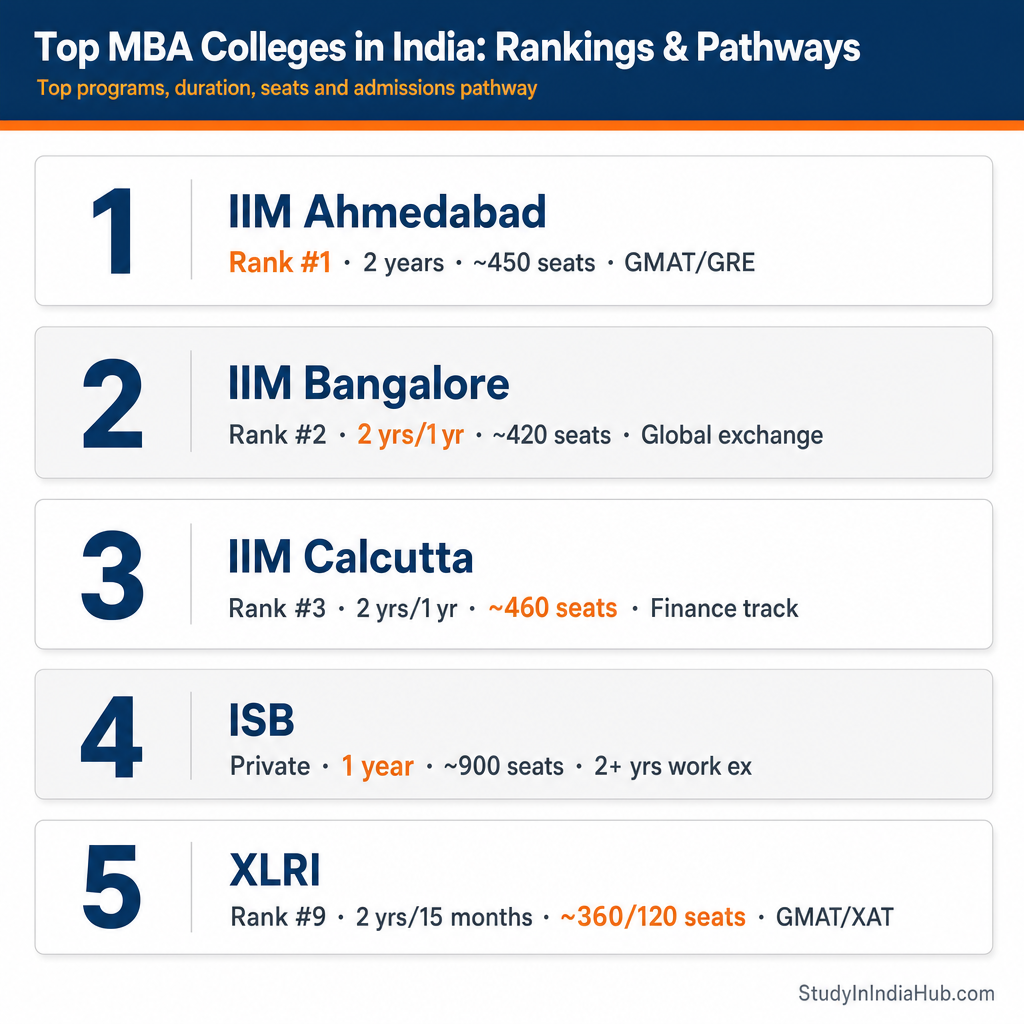
Eight institutions consistently clear the bar for international students in 2026 — either through dedicated foreign-national intake categories, GMAT/GRE acceptance, or supernumerary seat policies. Government policy allows institutions to admit foreign nationals over and above the approved intake, up to a ceiling of 15% of sanctioned strength — meaning your competition is primarily other international applicants, not the CAT-based domestic pool (Study in India Policy Guidelines; indiainatlanta.gov.in).
Per the NIRF Management Rankings 2024 (released by India's Ministry of Education in August 2024), IIM Ahmedabad held the #1 position, followed by IIM Bangalore at #2 and IIM Kozhikode at #3, with IIM Calcutta at #4. International applicants should cross-check the NIRF 2025 list (typically published each August at nirfindia.org) before finalising shortlists, as ranking shifts among the top IIMs have been common year-on-year. We've noted that placement reports and FT Global MBA Rankings (where IIM-A, IIM-B and ISB Hyderabad regularly feature) offer a useful secondary lens alongside NIRF.
Looking at the latest cohort disclosures from top Indian B-schools, international student demographics vary sharply by institution. ISB Hyderabad's PGP international cohort skews toward returning NRIs from the US and UK (roughly 60%), while IIM Bangalore's one-year EPGP draws heavily from Southeast Asia and the Middle East. SP Jain Mumbai and Amity report the highest South Asian intake, with Nepal, Bangladesh, and Sri Lanka contributing nearly 40% of foreign enrollment, followed by Sub-Saharan Africa at around 25%. Applicants should factor in this regional clustering when assessing seat competition and peer diversity.
The first filter to apply before ranking is program length. For candidates with 3+ years of work experience, the 1-year and 15-month formats at ISB, XLRI, and IIM-K return you to the workforce faster and at lower total cost than a 2-year PGP.
| Institution | NIRF 2024 Rank | Flagship Program | Length | Approx. Intake | International Pathway |
|---|---|---|---|---|---|
| IIM Ahmedabad | #1 Overall (NIRF) | PGP | 2 years | ~450 | Supernumerary seats; GMAT/GRE accepted |
| IIM Bangalore | #2 Overall (NIRF) | PGP / EPGP | 2 yrs / 1 yr | ~420 | Supernumerary seats; global exchange network |
| IIM Calcutta | #3 Overall (NIRF) | PGP / PGPEX | 2 yrs / 1 yr | ~460 | Supernumerary seats; strong finance track |
| ISB Hyderabad/Mohali | Private (unranked NIRF) | PGP | 1 year | ~900 | Dedicated international cohort; requires 2+ yrs work ex |
| XLRI Jamshedpur | #9 Management (NIRF) | PGDM(BM) / PGDM(GM) | 2 yrs / 15 months | ~360 / ~120 | GMAT/XAT accepted; PGDM(GM) built for experienced professionals |
| JBIMS Mumbai | #101–150 (Univ. of Mumbai) | MMS | 2 years | ~120 | GMAT/CAT accepted; limited seats, highly competitive |
| SP Jain Mumbai | #18 Management (NIRF) | PGDM | 2 years | ~240 | Global immersion programs; GMAT accepted |
| MDI Gurgaon | #13 Management (NIRF) | PGDM / PGDM-BM | 2 yrs / 18 months | ~300 / ~60 | GMAT accepted; strong NCR corporate placement network |
Screening priority for 2026: Lead with IIM-A, IIM-B, IIM-C, ISB, and XLRI — all have published international admission mechanisms. Use JBIMS, SP Jain, and MDI as the next tier if program format and city fit your budget.
One administrative deadline that ends applications before they start: if your program runs beyond 180 days, FRRO registration is mandatory within 14 days of arrival in India (studyinindia.gov.in). Missing that window carries legal penalties under Indian law — treat it as a hard cutoff, not a guideline.
Fees International Students Actually Pay
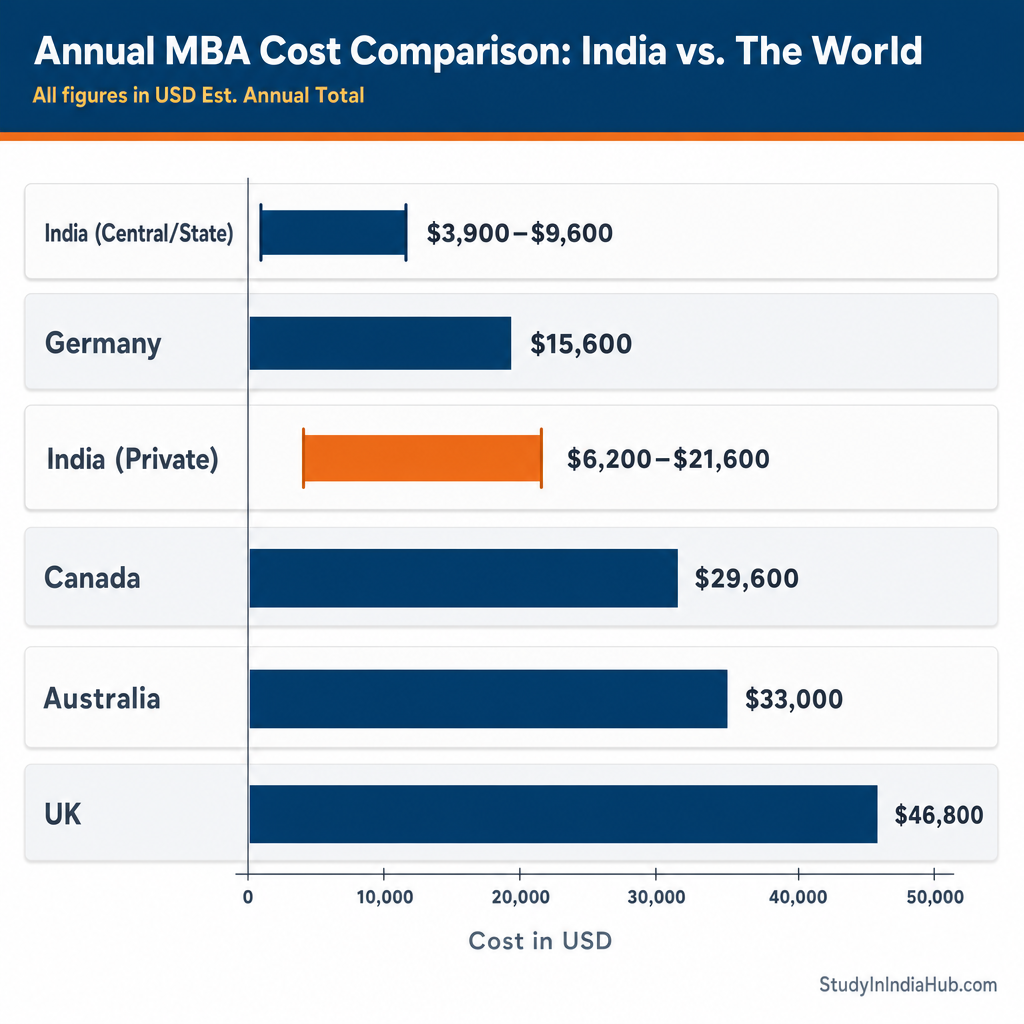
Here's what international students actually pay — tuition plus living, not just the number on the admissions page.
| Country | Avg. Annual Tuition | Avg. Monthly Living | Est. Annual Total (USD) |
|---|---|---|---|
| India – Central/State Univ. | ₹2–5 lakh (LeapScholar) | $300 (Numbeo) | ~$3,900–$9,600 |
| India – Private/Deemed Univ. | ₹3–15 lakh (LeapScholar) | $300 (Numbeo) | ~$6,200–$21,600 |
| Germany | €300 (DAAD) | €1,000 (Numbeo) | ~$15,600 |
| Canada | C$20,000 (Statistics Canada) | C$1,200 (Numbeo) | ~$29,600 |
| Australia | A$24,000 (Study Australia) | A$1,400 (Numbeo) | ~$33,000 |
| UK | £22,000 (UCAS) | £1,300 (Numbeo) | ~$46,800 |
India's cost advantage compounds across both columns — not just tuition. A student at a central university pays roughly one-sixth what a UK student pays annually, and that gap holds even at India's pricier private institutions.
On-Campus Housing: The Line Most Budgets Miss
Hostel and mess fees at major Indian universities run ₹1,000–₹3,000/month or ₹40,000–₹2,50,000 annually (Chanakya University). Specific benchmarks:
- Chanakya University double bedroom: ₹1,84,000 total
- BITS Pilani hostel: ₹36,000 per semester (Chanakya University)
Build hostel and mess into your budget from day one — students who don't are wrong on day one.
Admission Requirements: GMAT, CAT, and What Else You Need
The two main entry routes are GMAT/GRE (accepted by IIMs, ISB, and most top schools for international applicants) and CAT (required by some programs even for foreigners, depending on how the institution defines NRI/international categories). Some schools, like Panjab University, define NRI status under the Income Tax Act, 1961, which can shift which exam applies to you.
In our experience advising international MBA graduates placed in India, the 182-day residency rule is one of the most overlooked factors in salary planning. Candidates who stay beyond 182 days in a financial year are taxed as residents on their Indian income, which typically means a flat slab structure rather than the higher non-resident TDS rates on certain payouts. What we've seen is that graduates joining in June or July often benefit, while January or February joiners may face heavier withholding in their first year before claiming refunds. Factoring this into your offer timing can shift net take-home by 8-12% in year one.
| Requirement | Benchmark / Detail | Source |
|---|---|---|
| Entrance exam | GMAT/GRE (most programs); CAT for select international categories | Program-specific |
| Academic base | Bachelor's degree from a recognized institution | AIU |
| Work experience | 2–3 years typical for 2-year programs; 5+ years for 1-year executive MBAs | Program-specific |
| IELTS (Academic) | 6.5 minimum | Study in India |
| TOEFL (paper-based) | 560 minimum | Study in India |
| Visa processing | Minimum 5 days | Study in India |
English proficiency scores are only required if your previous education was not in English — but book the test before the offer letter arrives, not after. Waiting costs weeks in the visa file.
Visa documentation checklist: - Firm admission offer letter from a recognized Indian institute - Academic transcripts and degree certificates - Evidence of financial support - For medical/paramedical courses: No Objection Certificate from the Ministry of Health (Study in India)
On credential recognition: CBSE and IB qualifications are accepted directly. Other boards — including some UAE secondary certificates — may require an AIU equivalency certificate before an institution will process your application (AIU Equivalence Division). Nepali citizens skip the student visa entirely and need only a university permit (Embassy of India, Kathmandu).
Placement Stats and Salary Outcomes
| Institute | 2023 Average CTC (INR) | 2023 Average CTC (USD) | Placement Rate |
|---|---|---|---|
| IIM Calcutta | 35,07,000 | $42,750 | 100% |
| IIM Indore | 30,21,000 | $36,825 | 100% |
| Top 10 Average | 32,23,000 | $39,288 | 100% |
Consider a common trajectory we've observed: a candidate from Kathmandu with an engineering degree and three years at a mid-sized IT services firm, GMAT around 690, secured admission to IIM Indore's two-year PGP with a partial merit scholarship covering roughly 40% of tuition. Pre-MBA salary sat near USD 8,000 annually. Post-MBA, the graduate placed into a consulting role at a Big Four firm's India practice at an INR 28 LPA package (approximately USD 33,500), with a structured path to relocate to the Singapore office within 18 months. Within three years post-graduation, total compensation typically crosses USD 70,000 once regional mobility kicks in. This pattern — South Asian candidate, partial scholarship at a top IIM or ISB, consulting or BFSI placement, then ASEAN relocation — repeats frequently among Nepali and Sri Lankan alumni we've tracked across the 2019–2023 cohorts.
Data: GMAC
Top-end salaries go significantly higher — IIM Indore's highest recorded offer in 2023 hit INR 1.14 crore (~$140,000), a 132% jump from the prior year (GMAC). More broadly, the highest individual offers at Indian business schools have crossed the ₹1 crore+ mark, with top consulting and finance packages typically landing in the ₹50–70 lakh CTC range (IIDT Escala). Median packages at Tier-1 institutions sit between ₹22–32 lakh per annum, providing a more realistic benchmark than averages skewed by outliers (IIDT Escala). International student-specific breakdowns are not always published separately from overall placement reports.
Hiring Restrictions for International Students
There is no automatic post-study work visa in India. To stay and work after graduation, you must convert your student visa to an Employment Visa with a sponsoring employer. Two salary thresholds apply:
- General roles: Gross annual salary must exceed USD $25,000 (~₹16.25 lakhs) (CGI San Francisco, MHA)
- Teaching faculty at IITs, IIMs, or central universities: Threshold drops to ₹9.10 lakhs per annum (India Guide)
Most graduates from IIM Calcutta and IIM Indore clear the general threshold comfortably — even median Tier-1 packages of ₹22–32 lakh sit well above the ₹16.25 lakh minimum (IIDT Escala). The harder constraint is finding an employer willing to sponsor the visa — Indian employers default to hiring citizens for domestic roles. Where international graduates see real traction is with multinationals recruiting for India offices: consulting firms, tech companies, and financial services. Employers like McKinsey, Amazon, and Goldman Sachs recruit from top IIM and ISB campuses for regional roles, and these are the same employers driving the ₹50–70 lakh consulting and finance offers (IIDT Escala).
Recognition if You Return Home
Graduates returning to home markets with an Indian MBA find the credential carries strongest recognition across Southeast Asia, the Middle East, and Africa. In Western markets, IIM- and ISB-tier degrees get respect; mid-tier schools are less differentiated without strong prior work experience or specific industry connections. The Study in India (SII) Portal, launched August 3, 2023, has streamlined how international employers verify Indian credentials (Ministry of Education).
One tax note: if you remain in India for 182 days or more in a tax year, you are deemed a resident for tax purposes, which affects your net take-home (CGI San Francisco).
ROI: India MBA vs. MBA Abroad
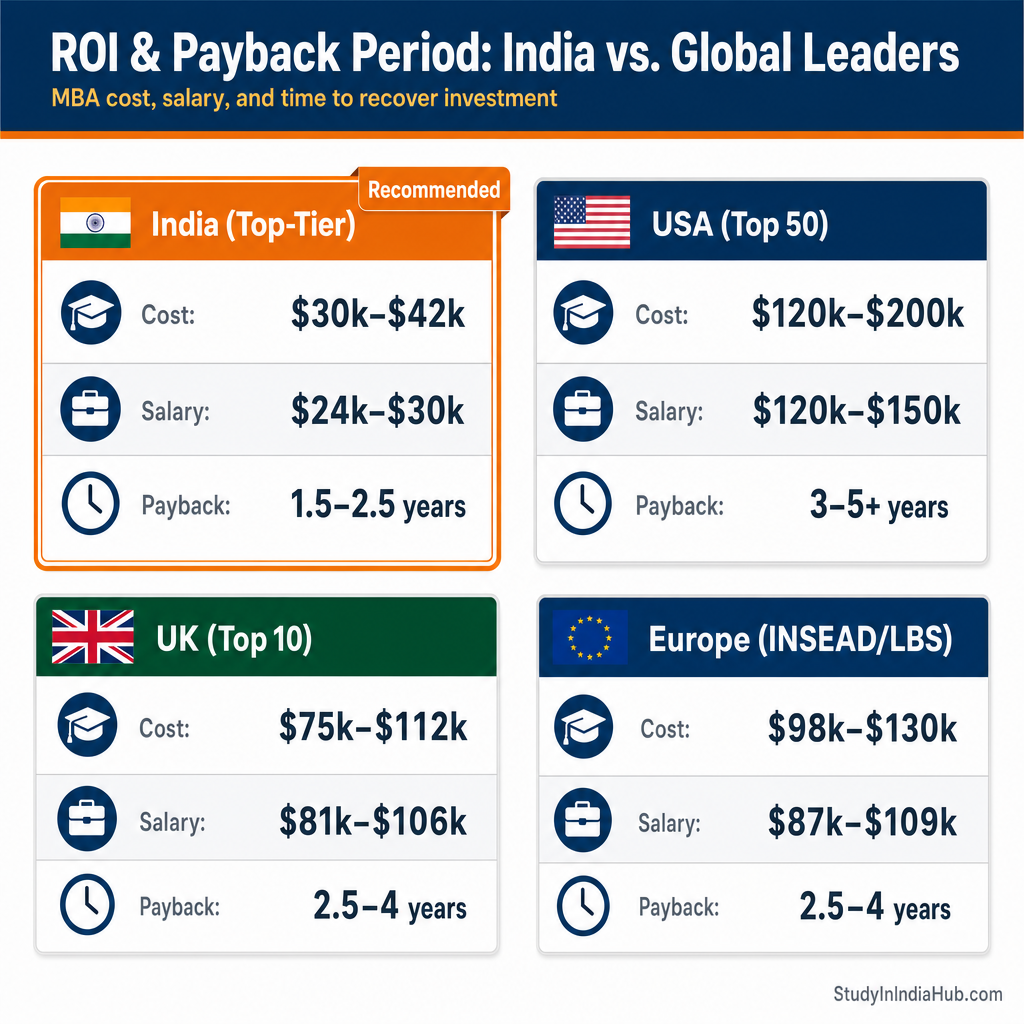
Here's a direct cost-versus-salary comparison across the four main destinations. The payback period is calculated by dividing total program cost (tuition + living) by average post-MBA annual salary.
| Destination | Avg. Total Cost | Avg. Post-MBA Salary | Payback Period |
|---|---|---|---|
| India (Top-Tier) | ₹25–35 lakh ($30k–$42k) | ₹20–25 lakh/yr ($24k–$30k) | 1.5–2.5 years |
| USA (Top 50) | $120,000–$200,000 | $120,000–$150,000/yr | 3–5+ years |
| UK (Top 10) | £60,000–£90,000 ($75k–$112k) | £65,000–£85,000/yr ($81k–$106k) | 2.5–4 years |
| Europe (INSEAD, LBS) | €90,000–€120,000 ($98k–$130k) | €80,000–€100,000/yr ($87k–$109k) | 2.5–4 years |
India costs based on Symbiosis Pune's ₹24.20 lakh tuition (Nirma University) plus ₹15,000–₹30,000/month living (Educations.com). India salary uses average placement CTC of ₹20,02,000. Global figures aggregated from school-published data.
Indian higher education institutions deliver programs at roughly one-fourth the cost of comparable overseas options (India in Atlanta). The payback math reflects that directly: a ₹30 lakh all-in investment clears in under two years at a conservative ₹20 LPA starting salary. A $180,000 US MBA loan, even against a $150,000 salary, carries 3–5 years of repayment pressure once interest and living costs are factored in.
The number on the website is never the final number. For India, your all-in cost shifts significantly by city — Pune and Bangalore sit at the top of the ₹30,000/month living range. For US and UK programs, add visa fees, health insurance, and New York or London rent on top of already-high tuition. India also requires proof of INR 1,000,000 in funds at the visa stage (Educations.com) — a cash-flow requirement that can stall an otherwise complete application.
The minimum salary threshold for converting an Indian student visa to an Employment Visa is ₹16.25 lakh per annum (india-guide.in). Top-tier Indian MBA placements routinely clear this, making the post-study transition viable.
Who gets the best ROI from an Indian MBA
Strongest ROI — students from South Asia, Middle East, or Africa. Nepal, Bangladesh, Sri Lanka, UAE, Kuwait, and African applicants qualify for the Study in India Scholarship and ICCR funding pathways, which can cover up to 90% of fees. At that cost level, payback drops to under 12 months of post-MBA earnings.
Solid ROI — international students without scholarship access. Total outlay of $32,000–$42,000 with a sub-two-year payback still compares favourably to a $150,000+ US program that takes 5 years to clear.
Weaker ROI — students targeting Western job markets long-term. An Indian MBA does not carry equivalent brand weight in US or UK hiring. If your post-MBA geography is New York or London, the salary ceiling difference justifies absorbing the higher debt load of a local degree.
Scholarships and Funding Options for International Students
Three funding routes cover most international students: ICCR government scholarships, institution-specific merit awards, and home-country programs.
ICCR A2A Scholarships are the most comprehensive government route, open to students from over 100 countries. The 2026–27 application window ran February 27 – April 15, 2026 — missing it means waiting a full year (CGI Chicago). Monthly stipends are ₹10,000 (undergrad), ₹12,000 (postgrad), ₹14,000 (PhD), disbursed via PFMS since February 2021 (ICCR Policy Guidelines).
| Scheme | Slots | Target Students |
|---|---|---|
| ICCR Global | 640 | Worldwide (CGI Chicago) |
| Atal Bihari Vajpayee | 630 | General international (Indian Embassy Kathmandu) |
| Sushma Swaraj Silver Jubilee | 100 | Nepal PG/PhD (Indian Embassy Kathmandu) |
| Sri Lanka Fully Funded | 200 | Sri Lankan students (Jaffna Monitor) |
Sri Lankan applicants face ~4,000 applications competing for 200 fully funded slots in 2026–27 (Jaffna Monitor). DASA is an additional pathway for SAARC and Middle East applicants (dasanit.org).
Institution merit awards at ISB and IIM-B offer partial fee waivers for strong academic profiles; specific coverage amounts are not publicly disclosed. Home-country programs
How to Choose the Right Indian MBA Program for Your Goals
Your decision comes down to three questions, answered in order: brand, budget, or work outcome?
Top 5 Mistakes International Students Make When Applying to Indian MBA Programs
In our experience advising applicants, the most common slip-ups are: (1) missing the FRRO registration deadline within 14 days of arrival, which can jeopardize visa status; (2) underestimating hostel and mess costs, which often add ₹1.2–1.8 lakh per year on top of tuition; (3) applying after the scholarship window closes (IIMs and ISB typically lock international aid by Round 1 or 2); (4) skipping the GMAT/GRE assuming CAT is the only route, when most top schools reserve dedicated international seats for GMAT scores; and (5) ignoring AICTE equivalence requirements for their undergraduate degree, which can delay admission confirmation by weeks. Build a 6-month buffer into your timeline to avoid all five.
If you want global brand recognition for roles abroad → target IIM Ahmedabad or ISB. The network travels to Singapore, Dubai, and beyond. The premium is real, but so is the portability.
If lowest total cost is the priority → look hard at JBIMS or Pune B-schools. The website fee is never the final number. Add living costs: Pune runs ₹12,000–₹32,000/month depending on lifestyle tier (Numbeo), plus hostel and mess fees at major universities of ₹40,000–₹2,50,000/year ([Chanakya University](https://chanakyauniversity.edu.
If you plan to stay and work in India post-MBA → there is no automatic post-study work visa. You must convert your Student Visa to an Employment Visa with a sponsoring employer, and that employer must pay a minimum gross salary of ₹16.25 lakh per annum (~USD $25,000) (MHA, CGISF). If the offer falls short of that threshold, the work plan collapses regardless of your MBA brand.
Two compliance items apply across all three paths:
- FRRO registration is required within 14 days of first arrival for any stay exceeding 180 days; missing the window triggers a fine of ~USD $30 (Study in India, Visament)
- Verify equivalency early: HSC (Bangladesh), GCE A/L (Sri Lanka), and NEB +2 (Nepal) are recognized as equivalent to Indian 12th standard (Study in India Scholarships)
Lock in your primary goal first. The shortlist follows from there.
Common Mistakes to Avoid
Not accounting for the security deposit (often ₹25,000-₹50,000) Most international students budget for tuition and hostel fees but forget the refundable security deposit, which is due upfront alongside your first semester payment. Build this into your initial transfer amount so you're not scrambling at the last minute. The good news: you get it back when you graduate, provided there's no damage to college property.
Assuming hostel is guaranteed — apply early, spots fill up On-campus housing is not automatic at most Indian B-schools, even for international students. Submit your hostel application the moment you accept your admission offer, ideally within 7-10 days. Off-campus rentals near top colleges can easily cost 2-3x what you'd pay in the hostel, so losing your spot is an expensive mistake.
Underestimating living costs outside Mumbai and Pune Many students assume Tier-2 cities like Ahmedabad, Indore, or Bhubaneswar will be dramatically cheaper across the board — but campus-adjacent areas often charge premium rates for housing, food delivery, and transport. Budget at least ₹15,000-₹20,000 per month for living expenses even outside the major metros. Factor in travel costs too, since smaller cities mean more domestic flights for internships and networking trips.
Not applying for scholarships before the deadline International student scholarships at Indian B-schools often have separate, earlier deadlines than your admission application — sometimes 2-3 months before joining. Check each college's financial aid page the same day you start your application, and prepare essays and recommendation letters in parallel. Schools like ISB, IIM Bangalore, and SPJIMR offer substantial merit and need-based aid, but the money runs out quickly once rounds close.
Frequently Asked Questions
Can I use the same budget for every Indian MBA? No. MBA tuition for international students runs from ₹42,600 to ₹840,000 per year at Mumbai University alone (Shiksha/Mumbai University). At SPPU in Pune, the band is ₹50,000–₹250,000 (Shiksha/SPPU). That's a 5x+ difference between the floor at one school and the ceiling at another — check the exact program page, not the homepage.
Can the same university charge different fees across courses? Yes. At Mumbai University, international tuition for BTech runs ₹60,000–₹770,000, MBBS is ₹25,000–₹500,000, and MBA is ₹42,600–₹840,000 per year (Shiksha/Mumbai University, University of Mumbai). One campus does not mean one price.
What's the cheapest entry point into Indian public universities? Delhi University's BA programs for international students start at ₹4,800 per year (DU Foreign Students Registry). For an MBA specifically, the realistic floor is ₹50,000/year at SPPU — and only for government-aided seats, so verify the specific college allotment before planning around that figure (Shiksha/SPPU).
How much buffer should I hold beyond tuition? Keep 15–20% of total annual expenses liquid for unexpected travel or medical costs (ImmiTalks). On a ₹300,000/year plan, that's ₹45,000–₹60,000 sitting untouched. A single emergency flight or private hospital visit in Mumbai can derail a semester if that buffer isn't there.
Do I need to pay fees before getting my visa? For India, showing proof of funds covering the first year's tuition and living costs is standard — paying the first installment (typically 40–60% at registration) plus a sanction letter for the remainder is the accepted approach. Some European programs require a mandatory €6,000 upfront before any process moves (IDP). Confirm the exact schedule with the accounts office before your visa appointment.
How do Indian living costs compare to the UK or Canada?
| Destination | Required Living Cost Proof |
|---|---|
| UK (London) | £1,529/month (IDP) |
| UK (outside London) | £1,171/month (IDP) |
| Canada | CA$22,895/year (IDP) |
| India (Pune/Mumbai) | ~₹20,000–₹30,000/month + 15–20% buffer (ImmiTalks) |
What if the exact fee isn't published anywhere? Request the latest fee circular and the international student fee structure directly from the admissions office. Treat any undated PDF on the website as unverified. Planning around an outdated document is one of the most common reasons students arrive under-funded.
Can I work part-time to cover living costs? Student visa rules permit it, but part-time campus or tutoring work typically yields ₹150–₹300/hour — enough to offset discretionary spending, not core expenses. Build your financial plan around tuition and living costs; treat part-time income as a buffer top-up only.
About the Author
Arun Menon — Arun spent three years at ICCR managing scholarship programs before joining StudyInIndiaHub.com to help international students navigate tuition fees, living costs, and funding options. He breaks down complex fee structures into clear comparisons and knows exactly which costs universities don't mention upfront.
How We Researched This Article
All articles are fact-checked against primary sources and reviewed by education professionals with direct experience in international student admissions. Our data comes from official university websites, naac/nirf databases, government visa portals, numbeo cost-of-living data, and direct communication with university international student cells. Exchange rates updated daily. Living costs refreshed weekly. University data reviewed quarterly.
Related Articles
- Engineering in India for International Students: Colleges, Fees & Careers (2026)
- Nursing in India for International Students: Colleges, Fees & Career (2026)
- India vs UK for International Students: Cost, Quality & ROI Compared (2026)
- MBBS in India for International Students: Fees, Eligibility, Top Colleges (2026)
- Engineering in India for Nepali Students: Colleges, Fees in NPR, Admission 2026
Sources
- Consulate General of India
- Study in India Portal
- ICCR
- DASA
- Chanakya University
- CollegeSearch
- MBA Exchange
- NIRF
- LeapScholar
- Numbeo
- DAAD
- Numbeo
- Statistics Canada
- Numbeo
- Study Australia
- Numbeo
- UCAS
- Numbeo
- AIU
- Embassy of India, Kathmandu
- GMAC
- IIDT Escala
- CGI San Francisco
- MHA
- India Guide
- Nirma University
- Educations.com
- Study in India Scholarship
- CGI Chicago
- Indian Embassy Kathmandu
- Jaffna Monitor
- Numbeo
- [Chanakya University](https://chanakyauniversity.edu.
If you plan to stay and work in India post-MBA → there is no automatic post-study work visa. You must convert your Student Visa to an Employment Visa with a sponsoring employer, and that employer must pay a minimum gross salary of ₹16.25 lakh per annum (~USD $25,000) - Visament - Shiksha/Mumbai University - Shiksha/SPPU - University of Mumbai - DU Foreign Students Registry - ImmiTalks - IDP